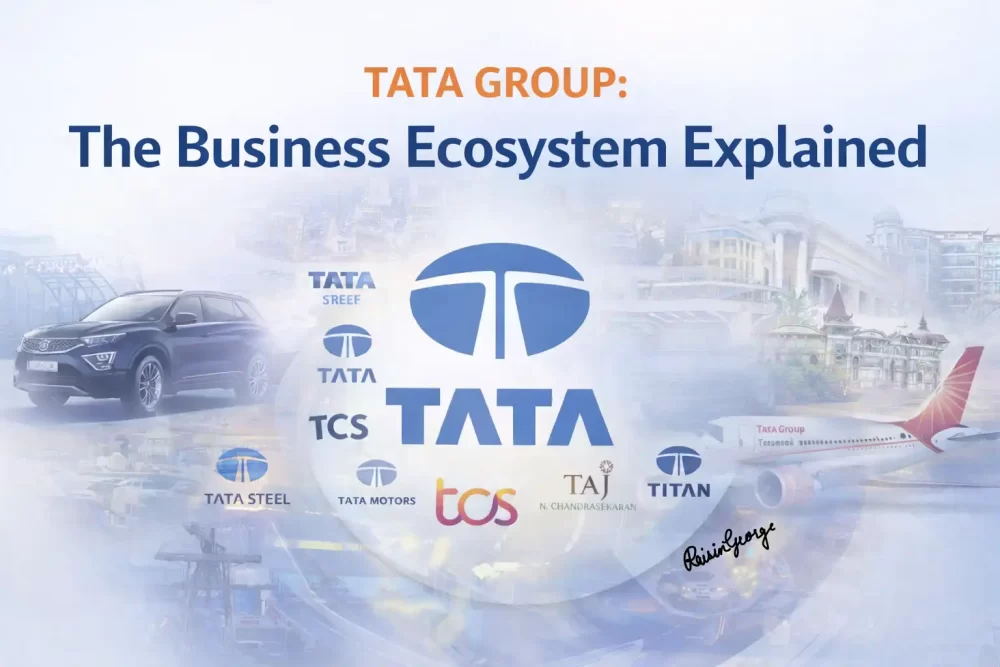
Most people think of Tata as a group of companies.
Steel. Cars. Salt. Hotels. Maybe TCS.
But that’s surface-level thinking.
Because once you step back, you realise something bigger.
Tata isn’t just operating businesses. It’s orchestrating an ecosystem.
It started with a vision, not a business
In 1868, Jamsetji Tata didn’t start a conglomerate.
He started with a simple idea.
Build what India doesn’t have.
That led to some of the earliest industrial bets in the country: steel, power, and hospitality.
Not for profit alone. But for nation-building.
From industrial house to global system
Over 150+ years, Tata didn’t just grow.
It layered capabilities.
From steel and power to automobiles.
From automobiles to global brands like Jaguar Land Rover.
From services to TCS becoming a global technology powerhouse.
The core insight: Tata is a federation
Most conglomerates are centrally controlled.
Tata is different.
At the top sits Tata Sons.
But below that, companies operate independently.
That means Tata is not one machine. It’s a network of machines.
- Strong central control
- Tighter operating command
- Faster alignment
- Independent operating companies
- Shared trust and brand power
- Long-term capital allocation
The ecosystem, simplified
Tata Sons, brand credibility, long-term allocation
Steel, power, mobility, chemicals, infrastructure
TCS, Titan, Tata Consumer, Trent, IHCL, Voltas
Tata Neu, Air India, electronics, batteries, defence systems
Breakdown of the key business units
Technology
TCS is the financial backbone. Tata Elxsi, Tata Technologies, and telecom infrastructure businesses deepen the tech layer.
Mobility
Tata Motors spans trucks, cars, EVs, and premium global mobility through Jaguar Land Rover.
Materials
Tata Steel and Tata Chemicals keep the group tied to the real economy and industrial supply chains.
Consumer
Titan, Tata Consumer, Trent, and Voltas show how Tata turns trust into daily demand.
Energy & Infra
Tata Power and related infrastructure businesses connect legacy strength with future energy transition.
Travel & Hospitality
IHCL and Air India place Tata inside the premium travel and service economy in a big way.
Digital Layer
Tata Neu, BigBasket, 1mg, and Croma reflect the push to connect separate businesses digitally.
Defence & Aerospace
This is the least visible Tata layer, but one of the most strategic, especially through Tata Advanced Systems.
How the system actually works
Think of Tata as a flow, not a list.
Money flows from stable businesses like TCS. That supports long-term bets like aviation, electronics, batteries, and digital consumer platforms. Each layer strengthens the other.
What makes Tata different
Most companies optimise for efficiency.
Tata optimises for longevity.
That shows up in its ownership structure, its diversification, its partnerships, and the way it enters new sectors with credibility already built in.
It doesn’t try to win one market. It tries to stay relevant across many important ones.
Tata’s edge is not just scale. It is structure.
The trade-off
This model is powerful, but not perfect.
- Complexity
- Slower decision-making
- Capital-heavy bets
- Execution across many sectors
Final takeaway
Tata is not trying to be the best in one category.
It is trying to be relevant in every important category.
That is why it has survived for more than 150 years.
And that is why it still matters.
Explore the full ecosystem breakdown below
If the viewer doesn’t load, click here to view the PDF.
Please rate my work
Your page rank: