
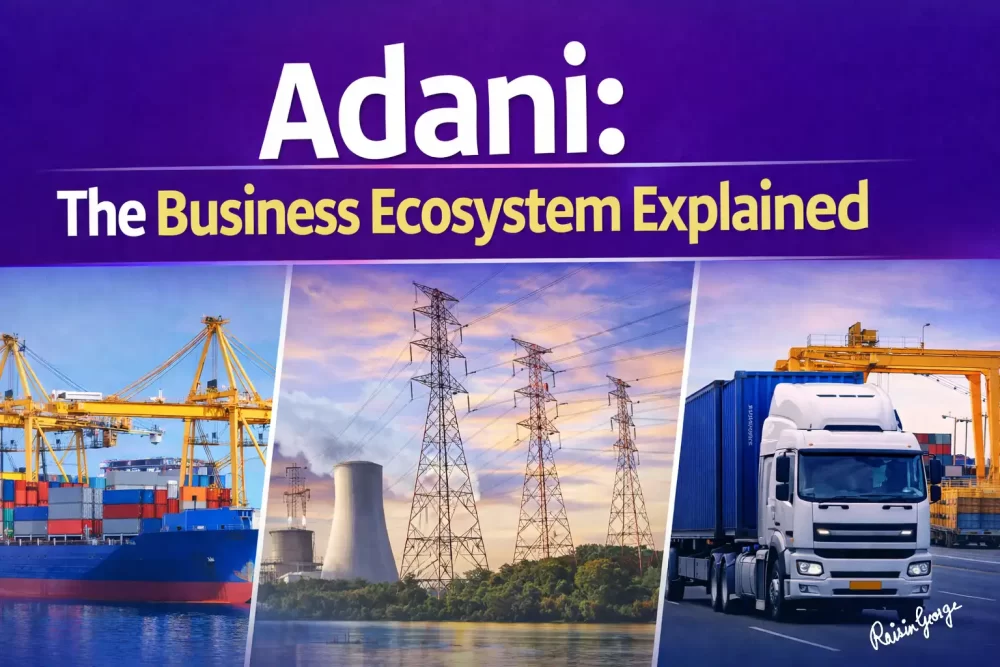
Most people try to understand Adani by looking at its companies.
Ports. Power. Airports. Cement. Media.
It looks like expansion in every direction.
But that’s not what’s really happening.
Adani is not a collection of businesses.
It is a system built around one idea.
Control how energy and goods move.
It Started With Access
Adani did not begin with infrastructure.
It began with trading.
In 1988, the business was about moving commodities. But trading has a limitation. You depend on someone else’s network.
Ports changed that.
Once Adani built control over ports, it was no longer dependent on the system.
It became the system.
From Entry Point to Control
A port is not just a physical asset.
It is a control point.
Everything that enters or leaves a country passes through it.
Once Adani controlled ports, it gained visibility and influence over cargo.
From there, expansion was not random.
It was logical.
Ports led to logistics.
Logistics created industrial demand.
Industry needed energy.
And the system started building itself.
The Core Adani Loop
What looks like diversification is actually a repeating infrastructure loop.
The Core Loop
At the centre of Adani’s model is a simple loop.
Cargo comes in through ports.
That drives industrial activity.
Industry consumes energy.
Energy enables production.
Production generates more cargo.
And the cycle repeats.
This is not diversification.
This is reinforcement.
Energy Is the Multiplier
Energy is where the system becomes powerful.
Adani is present across the chain.
From generation to transmission to distribution.
This matters because energy is not just another sector.
It is the foundation of every sector.
Without energy, logistics slows down.
Without energy, industry weakens.
With energy, everything scales.
Logistics: The Invisible Advantage
Ports are visible.
Power plants are visible.
Logistics is not.
But logistics is what connects everything.
Rail networks. Roads. Warehousing.
This is where control becomes real.
Because once you control movement, you control efficiency.
And efficiency decides who wins at scale.
Core system vs adjacent businesses
Ports, logistics, energy, utilities, airports, cement, mining
Media, FMCG, data centres, defence, real estate
Airports: Control Without Ownership
Airports show how Adani operates differently.
It does not always own the asset.
It operates it.
Across major Indian cities, Adani manages airports that handle a significant share of passenger and cargo traffic.
This is important.
Because influence does not always require ownership.
Cement: Completing the Loop
The move into cement may look like diversification.
It is not.
It completes the system.
Ports bring in raw materials.
Energy powers production.
Logistics distributes output.
And cement feeds infrastructure.
Cities. Roads. Construction.
The system closes on itself.
India at the Core. Global at the Edges
Adani’s strength is built in India.
Ports. Airports. Transmission networks. Cement plants.
That is where scale comes from.
But the system extends globally.
Mining in Australia.
Ports outside India.
Partnerships across energy and technology.
India provides depth.
Global presence provides leverage.
India
- Ports and inland logistics
- Transmission and utilities
- Airports and cargo flows
- Cement and industrial materials
- Urban infrastructure and energy demand
Global
- Australia mining and rail links
- International port exposure
- Energy and technology partnerships
- Global capital and infrastructure tie-ups
- Leverage beyond domestic growth
What Sits Outside the Core
Not everything in the group is part of the core system.
Media. FMCG. Data centres. Defence.
Some of these are strategic.
Some are exploratory.
But the real strength of Adani lies in infrastructure.
That is where everything connects.
The Trade-Off
This model is powerful.
But it comes with trade-offs.
It requires significant capital.
It depends on regulation.
It operates under constant scrutiny.
Scale creates advantage.
It also creates pressure.
The trade-off behind scale
What Makes Adani Different
Most companies grow by entering new markets.
Adani grows by connecting them.
Each new business reduces friction.
Each layer strengthens the previous one.
That is why the system works.
Final Thought
Adani does not just build companies.
It builds infrastructure that others depend on.
And when you control infrastructure, you do not just grow with the economy.
You grow with everything that moves through it.
Explore the full ecosystem breakdown below
View and download the full Adani case study deck.
Adani Group: The Infrastructure Engine of India
View and download the full case study deck.
If the document does not load, click here to view it .
Please rate my work
Your page rank: