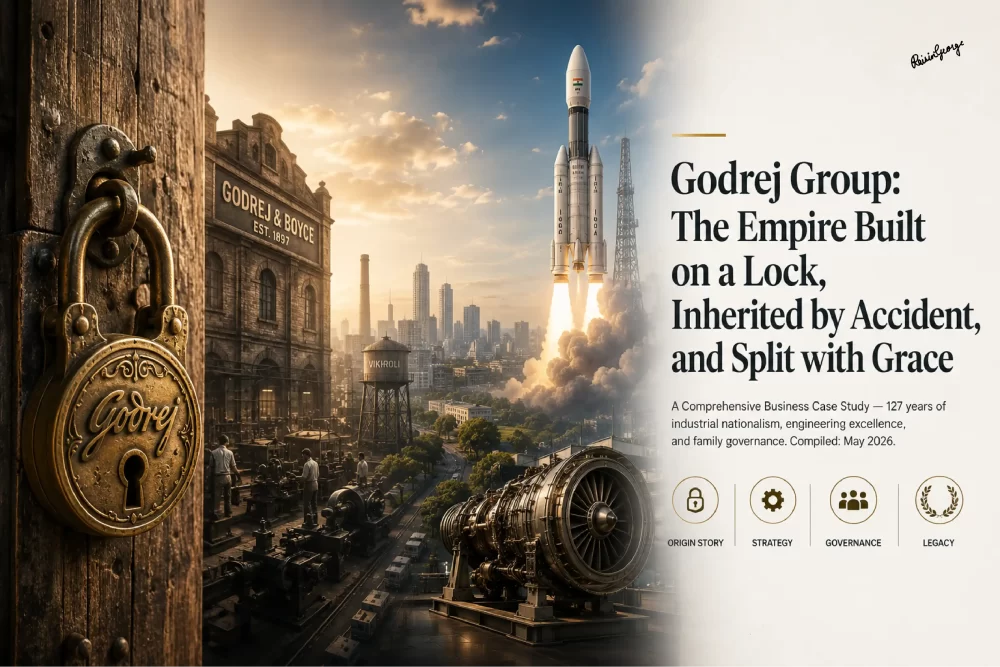
Godrej Group: The Empire Built on a Lock, Inherited by Accident, and Split with Grace
127 years of industrial nationalism. A ₹1 lakh crore land bet made in 1943 on marshy village ground. A lock company that builds rocket engines for ISRO. And a family split that became India's most studied governance masterclass.
The Lawyer Who Quit, and the Question That Built an Empire
Ardeshir Godrej was born in 1868 into a wealthy Parsi family in Bombay. His family name wasn't even Godrej — his father changed it from Gootherajee when Ardeshir was three years old. He trained as a lawyer, graduated, and almost immediately grew disgusted with the profession. His view of law, by reputation: a career built on lies. He quit.
In 1894 he took a job at a chemist's shop, became fascinated by precision manufacturing, and tried his hand at making surgical instruments. The venture failed. The Indian market didn't trust Indian-made medical tools. Everything clinical was imported from England, and doctors preferred it that way.
Rather than giving up, Ardeshir reframed the question entirely. It is this reframe — not his eventual success — that makes his story worth studying:
"What do people need that they cannot get from Britain — and which an Indian manufacturer could actually make better?"
Ardeshir Godrej's operating thesis, 1897 — repeated in different forms across 127 yearsIn 1890s Bombay — a city with rising crime, imported colonial wealth, and unreliable imported locks — the answer was clear. British locks had an integrated spring that frequently broke. Ardeshir designed his without it. The Godrej springless lock, patented, was introduced in 1902 and became a sensation. The British were selling Indians inferior locks. Ardeshir was now beating them on their own terms.
Ardeshir was not an entrepreneur in the modern sense. He was an industrial nationalist. He identified market gaps where India was dependent on imports and systematically filled them — with better products, at lower prices, made by Indian workers. This philosophy predated "Atmanirbhar Bharat" by a century, and predated Indian independence by decades.
The Founder Died Without Children. And That Changed Everything.
Ardeshir Godrej died in 1936. He had no children. The entire empire — locks, soaps, the emerging industrial complex in Lalbaug — passed entirely to his brother Pirojsha's family. One of India's great industrial dynasties was never actually meant to be a dynasty.
Pirojsha had four children: Sohrab, Burjor, Naval, and a daughter Dosa. Sohrab died without children. Dosa's child Rishad also had no children of his own. This meant that by the third generation, the Godrej inheritance had concentrated — entirely by the accident of biology — into just two family branches:
Burjor's sons: Adi and Nadir Godrej — who would come to lead the listed, consumer-facing companies (GCPL, Godrej Properties, Godrej Agrovet).
Naval's children: Jamshyd Godrej and Smita Godrej Crishna — who would come to lead the unlisted engineering empire (Godrej & Boyce, aerospace, the Vikhroli land bank).
These are the four cousins whose names would appear on a legal filing 88 years later: the Great Split of 2024. The fortune Ardeshir built was inherited by accident. And yet it held together for over a century before finally, gracefully, dividing.
1,400 Tonnes of Explosives. 1,300 Dead. One Godrej Safe Survived.
On April 14, 1944, the SS Fort Stikine — a British cargo vessel carrying ammunition and cotton bales in Bombay Harbour — caught fire and detonated. The explosion, one of the worst maritime disasters in Indian history, killed an estimated 1,300 people, destroyed hundreds of buildings, and sent shrapnel across the entire dockyard.
When rescue workers searched the wreckage of the ship, they found something remarkable: among the ruins, a Godrej safe — its contents perfectly intact.
Ardeshir had already retired to farming in Pune by this point, and never saw the moment. But the explosion did something no advertising campaign ever could. It demonstrated, in the most literal and catastrophic way possible, that Godrej made things that lasted. The company reportedly used the phrase for years without embellishment: "The only thing recovered from the Fort Stikine."
"We continue to outsource rigorous product testing."
Godrej Aerospace Business Head SM Vaidya, tongue firmly in cheek, recounting the 1944 story decades laterHe Bought Marshy Village Land at an Auction. It's Now Worth ₹1 Lakh Crore.
In 1943, the Government of Bombay auctioned Vikhroli village at the Bombay High Court. The land was marshy, undeveloped, on the northeastern edge of the city. Pirojsha Godrej — Ardeshir's brother, the manufacturing brain of the operation — bid and won. His vision was not to flip the land. He wanted to build a township.
Over the following two decades, Vikhroli transformed into Pirojshanagar — a self-contained industrial community with manufacturing plants, subsidised worker housing, dispensaries, a school for workers' children, and a community welfare centre called Pragati Kendra. And on its northern edge, deliberately preserved, a 200-acre mangrove forest that Pirojsha placed under conservation — the largest privately owned mangrove reserve in Mumbai, in 1943, decades before "sustainability" entered the corporate vocabulary.
Acquired 1943
Protected Forever
Core Value Driver
at Mumbai Rates
In 2011, Adi Godrej made a public, irrevocable commitment: the 1,750 acres of mangroves within the Vikhroli estate would never be developed. A lock company was sitting on India's most valuable private urban land bank — and it had voluntarily ring-fenced more than half of it for conservation.
The development model, preserved even after the 2024 split, is structurally elegant: Godrej & Boyce (GEG side) owns the land as owner-developer. Godrej Properties (GIG side) acts as development manager, earning approximately 10% of project revenues. Both entities share the upside from the same land across two legally separated empires.
The Same Company That Made Ballot Boxes Now Builds India's Crewed Spacecraft Engine
In 1985, ISRO approached Godrej & Boyce for help manufacturing satellite and rocket parts. The logic was Godrej's reputation for precision machining — the same discipline behind their locks and safes. Four years later, in 1989, Godrej won the ISRO tender to manufacture the Vikas engine for PSLV's second stage — 75 tonnes of thrust, built by a company that had started by selling locks in a Lalbaug shed.
Godrej Aerospace is a single-source supplier for multiple ISRO programmes — present in every PSLV and GSLV launch in Indian history. Over 40 years, this position is effectively irreplaceable. The institutional trust, technical certifications, and manufacturing infrastructure required to displace them would take a competitor 15+ years to build — at minimum.
Everyone Said Go to Europe. GCPL Went to Africa and Indonesia Instead.
When Godrej Consumer Products began its international expansion under Adi Godrej in the mid-2000s, the conventional corporate wisdom was clear: chase scale in Europe or North America, where consumers are wealthy and brand-building generates global prestige. GCPL looked at those markets and chose the opposite.
The 3x3 strategy: three continents (Asia, Africa, Latin America), three categories (home care, personal wash, hair care). All emerging markets. All high-population. All underserved by the global multinationals who were busy fighting each other in London and New York. Adi Godrej's rationale was explicit: "Close to 80% of the world's population lives and works in emerging markets."
The Key Acquisitions
The brilliance: GCPL now owns dominant market positions in categories that Western multinationals effectively abandoned. No global competitor has figured out how to displace them in Indonesian insecticides or Sub-Saharan African hair care — 15+ years of distribution depth, local formulation, and brand trust are extraordinarily difficult to replicate.
The risk: Currency volatility is now existential. The Nigerian Naira devaluation, Argentine Peso hyperinflation, and Rupiah movements can erase quarterly earnings gains without any operational failure. The same markets that offer the growth offer the volatility. They cannot be separated.
How Do You Divide a 127-Year Empire Without a Courtroom?
The Godrej split was not driven by a crisis or a feud. It was driven by structural inevitability: four branches of a family, with increasingly divergent visions, sharing cross-ownership in the same entities across generations. Jamshyd's side held stakes in GCPL and Godrej Properties. Adi's side held stakes in Godrej & Boyce. Every strategic decision at any entity technically required alignment across family branches with different priorities.
The negotiation process was long and methodical. As early as 2019, the two sides had engaged India's top legal advisors — Cyril Amarchand Mangaldas for the Adi/Nadir side; Zia Mody's AZB Partners and investment banker Nimesh Kampani for Jamshyd's side. It took five years. The announcement came on May 1, 2024.
Who Got What — And the Strategic Logic
| Entity | Went To | Strategic Rationale |
|---|---|---|
| Godrej Industries (listed) | GIG | Capital markets-facing; requires institutional investor discipline and quarterly accountability |
| GCPL (FMCG, listed) | GIG | Consumer brand empire; Adi's family's domain for three decades; 3x3 strategy well established |
| Godrej Properties (listed) | GIG | Real estate development; capital-markets discipline essential for large booking velocity |
| Godrej Agrovet (listed) | GIG | Agri and rural; fits GIG's consumer India focus; listed company governance suits the sector |
| Godrej & Boyce (unlisted) | GEG | Engineering heritage — Jamshyd's domain; fits patient-capital, unlisted structure |
| 3,400-acre Vikhroli land bank | GEG | Massive long-term asset; unlisted entity avoids quarterly pressure to monetise prematurely |
| Aerospace & Defence | GEG | Engineering-intensive; long gestation; ISRO contracts don't fit quarterly earnings scrutiny |
The most elegant element of the entire restructuring: G&B (GEG) retains the 3,400-acre Vikhroli estate as owner-developer. Godrej Properties (GIG) retains the right to act as development manager, earning ~10% of project revenues. Both sides benefit from Vikhroli regardless of which camp they're in. The split was structured to preserve, not destroy, this value-creation engine — a commercial bridge between two legally separated empires.
Five Reasons the Split Was "Amicable" — What That Actually Means
Indian conglomerate splits are almost universally acrimonious. The Ambani brothers. The Bajajss. The Birlas. Godrej's 2024 restructuring is being studied as a benchmark.
One Name. Two Empires. Each Built for a Different Time Horizon.
Consumer-Facing
- Godrej Consumer Products (GCPL) — soaps, insecticides, hair colour, ~50% international
- Godrej Properties — real estate; ₹34,171 Cr booking value FY26
- Godrej Agrovet — animal feed, dairy, crop protection; ₹10,233 Cr revenue FY26
- Godrej Industries — holding company; Chemicals, Godrej Capital (NBFC)
- Incoming Chairman (Aug 2026): Pirojsha Godrej
Engineering & Land
- Godrej Aerospace — ISRO partner, 175+ engines, Gaganyaan, 5th-gen jet engine ambition
- Godrej Security (Locks & Safes) — the original 1897 business, still running
- Godrej Appliances — lineage of India's first 1958 fridge
- Godrej Infotech — IT services for manufacturing sector
- 3,400-acre Vikhroli land bank (₹1 lakh crore+ estimated value)
The Numbers Beneath the Empire
The Fourth Generation Takes the Reins. Both Empires. Simultaneously.
The Godrej succession story is not historical. It is happening this month. In August 2026, as explicitly stated in the 2024 family settlement agreement, Pirojsha Godrej — son of Adi, 42 years old, the man who built Godrej Properties into India's most valuable listed real estate developer — succeeds Nadir Godrej as Chairman of the Godrej Industries Group.
On the GEG side, Nyrika Holkar — daughter of Smita Godrej Crishna, 42, Executive Director of Godrej Enterprises Group — has already been in operational charge, working alongside Jamshyd Godrej. The fourth generation is not waiting in the wings. They are already running the show.
What's unusual about this succession is its transparency. Both names were announced in the same legal filing as the split — not as rumours, not as announcements to be made later, but as binding commitments embedded in the restructuring agreement itself. The Godrej family treated leadership transition as a governance matter, not a personal one.
25% of the Company Belongs to the Public. Permanently. By Design.
One of the least-discussed aspects of the Godrej story is its ownership structure. Twenty-five percent of Godrej & Boyce's shares are held in charitable trusts — the Pirojsha Godrej Foundation, the Soonabai Pirojsha Godrej Foundation, and the Godrej Memorial Trust. This is not a corporate social responsibility programme. This is permanent, structural ownership of a share of the business locked away for public benefit, created by Pirojsha Godrej in the 1940s, before ESG was a framework and before CSR was a regulatory requirement.
The trusts fund the Godrej Memorial Hospital in Vikhroli, Teach for India's operations, WWF India partnerships, the 200-acre mangrove conservation reserve, and the school that Pirojsha built for factory workers' children in 1943.
"A business exists in relationship with the community that hosts it. This was not a philosophical position — it was an ownership decision."
The structural lesson of Pirojsha Godrej's trust framework, built in the 1940sThe governance dividend of this structure became apparent in 2024: decades of operating under genuine fiduciary oversight — not performative boards, but real institutional mechanisms — created an organisational culture where the 2024 split was negotiable rather than adversarial. The institutional habits of one generation became the conflict-resolution tools of the next.
The Risks That Could Bend a 127-Year Legacy
The Godrej Story Behind the Godrej Story
Read the Full Case Study
127-year timeline, detailed business model mechanics, ownership structure, complete risk register, and in-depth sections on every Godrej subsidiary — all in one document.
More Case Studies Like This
Deep research on L&T, Mahindra & Mahindra, Asian Paints, and India's most consequential businesses — structured for business-literate readers.
Browse All Case Studies →About This Research
This case study on the Godrej Group covers the complete business history of Godrej from 1897 to 2026, including the Godrej Industries Group (GIG) and Godrej Enterprises Group (GEG) post-split structure, the Vikhroli land bank, Godrej Consumer Products' 3x3 international strategy, Godrej Aerospace's ISRO partnership, the Godrej family split of 2024, and the succession of Pirojsha Godrej as Chairman of GIG in August 2026.
Key financial data covered: Godrej Properties FY26 booking value of ₹34,171 crore (+16% YoY), Godrej Agrovet FY26 revenue of ₹10,233 crore (+9%), GCPL Q4 FY26 revenue growth of +11% YoY, and Godrej Industries H1 FY26 net profit of ₹1,005 crore. All data sourced from publicly available company filings, investor presentations, and credible secondary sources.
Related searches: Godrej Group case study | Godrej family split 2024 | Godrej Industries Group vs Godrej Enterprises Group | Vikhroli land bank value | GCPL 3x3 strategy | Godrej Aerospace ISRO | Pirojsha Godrej 2026 | Indian conglomerate analysis | Godrej history origin story | Godrej business model
Please rate my work
Your page rank: