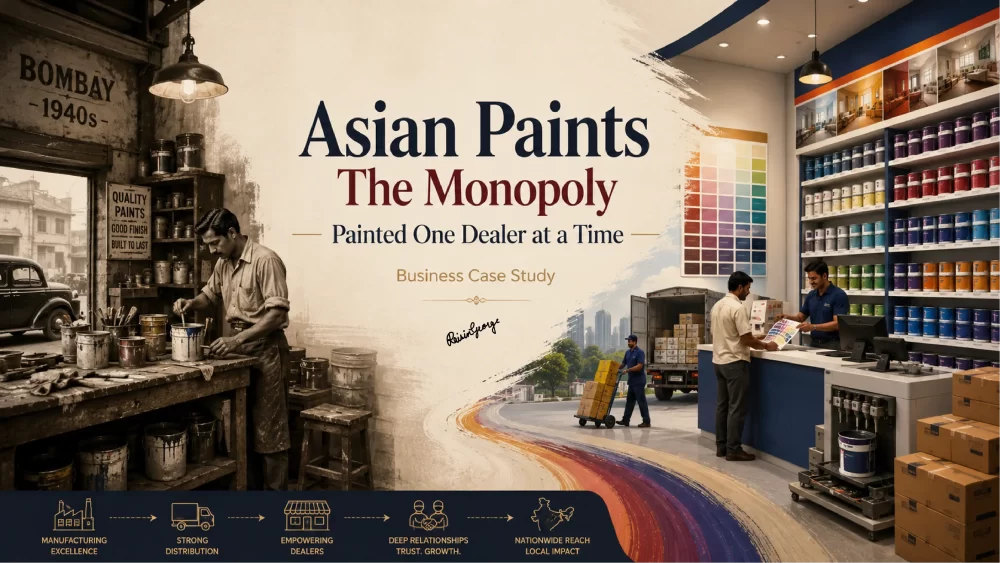
In February 1942, while Mahatma Gandhi was preparing the Quit India Movement in one corner of Bombay, four young Gujarati friends were doing something considerably more mundane in another. They rented a garage in Gaiwadi, Girgaon for ₹75 a month. They chose the company’s name at random from a telephone directory. They started mixing paint by hand over coal furnaces.
Eighty-three years later, the name they picked from that telephone directory — Asian Paints — is the market leader in India’s paint industry, as it has been continuously since 1967. It earns more in profits than the combined earnings of its three nearest domestic competitors. It deployed India’s first supercomputer ten years before ISRO did. It has outperformed most technology companies over a 30-year period, turning ₹13 into ₹2,900. And in 2024, for the first time in six decades, it faced a competitor with enough capital and distribution weight to genuinely challenge that dominance.
This article covers ten things about Asian Paints that explain how a company built in a garage with a random name became one of India’s most enduring commercial institutions — and what the Birla Opus challenge reveals about where that moat actually sits.
The complete 70-plus page case study — covering the founding in full, all four business segments, the supply chain model mechanics, the Birla Opus competitive battle, the home décor pivot, the ICI takeover drama, and the full financial profile — is available as a free PDF at the end of this article.
Origin1. The Company Name Was Chosen at Random From a Telephone Directory
The four friends — Champaklal Choksey, Chimanlal Choksi, Suryakant Dani, and Arvind Vakil — needed a name for their new company in February 1942. They opened a telephone directory. They picked a name that sounded reasonable. “The Asian Oil & Paint Company” was not the result of a branding exercise, a market study, or a strategic conversation about how the name should represent the company’s ambitions. It was the result of one page of a directory and a decision made quickly in a rented garage.
The garage itself cost ₹75 per month. Equipment consisted of coal furnaces and hand-stirring tools. The context was wartime: Britain had imposed a temporary ban on paint imports, leaving India with only Shalimar Paints and a handful of expensive foreign brands. The four friends saw a gap — not a destiny, not a national mission — and decided to fill it.
The scale of the accident: The name “Asian Paints” that was picked at random from a telephone directory in February 1942 is today one of India’s most valuable brand assets, with a market capitalisation of approximately ₹2.5 lakh crore. By 1952 the company had ₹23 crore in annual turnover. By 1967 it was India’s number one paint manufacturer. By 2026 it had 27 manufacturing facilities across 15 countries serving consumers in 60+ countries. The distance between a ₹75/month garage and ₹2.5 lakh crore of market value is 83 years of disciplined execution — built on a name that could just as easily have been something else entirely.
All four founders came from Gujarati Jain business families — a cultural context defined by conservative capital allocation, deep trading relationships built over generations, and commercial reputations treated as primary assets. These were not values imposed by a business school curriculum. They were inherited assumptions about how commerce works. They became the founding culture of a company that has now operated continuously for more than eight decades.
Distribution Revolution2. The Rejection That Built a 58-Year Monopoly
In the 1950s, India’s paint distribution was controlled by a small number of powerful wholesalers. These intermediaries held the keys to India’s retail hardware network — and when Asian Paints approached them in Mumbai and Pune, the dominant wholesalers said no. The new company was too small, too unproven, too much of a risk to their existing supplier relationships.
Champaklal Choksey and his partners did not negotiate harder. They went around. They packed their products and took them directly to hardware shopkeepers in smaller towns — the mom-and-pop stores that dominated retail commerce in Tier II and III India. It was a necessity born of exclusion. Over the following decade, it became the single most important strategic decision in the company’s history.
The margin arithmetic of going direct was decisive. Traditional distribution gave paint companies approximately 75 percent of the MRP as net revenue after distributor margins. Asian Paints’ direct model delivered approximately 95 percent. Applied across thousands of crores of annual revenue, the 20-percentage-point advantage was an enormous reinvestment resource — poured into technology, supply chain infrastructure, dealer loyalty programmes, and branding while competitors paid for equivalent reach at a permanent structural disadvantage.
The proprietary data consequence: Bypassing the wholesaler did not just improve margins. It gave Asian Paints something that proved more durable than the margin itself: direct visibility into every dealer’s sales velocity, colour preferences, seasonal patterns, and stock requirements. This data — accumulated transaction by transaction across 160,000+ dealer relationships since the 1950s — is the raw material for the demand forecasting system that allows Asian Paints to restock dealers 3–4 times per day while competitors manage weekly or biweekly delivery schedules. A competitor cannot buy 70 years of dealer transaction data. The exclusion from the wholesale system was not a setback. It was the origin of an irreplaceable competitive asset.
3. Asian Paints Bought India’s First Supercomputer — 10 Years Before ISRO
In 1970, one year after the moon landing, Asian Paints spent ₹8 crore — a significant sum for a paint company — on a CDC 6600 supercomputer. It became the first supercomputer in India. Not at ISRO. Not at IIT Powai. Not at a government research laboratory. At a paint company in Mumbai, a decade before the space agency and 21 years before any other Indian private company made an equivalent investment.
The decision was Champaklal Choksey’s, and its logic was operational rather than aspirational. Asian Paints was building a direct-to-dealer network across India with no wholesaler buffer. Thousands of small hardware stores, each with limited shelf space, served wildly different regional and seasonal demand patterns. Forecasting what shade of paint, in what tin size, in what quantity, needed to be at which store in which week — across the entire country — was a multivariate problem that no human planning team could solve at scale.
“Asian Paints was the first company in India to use technology — at the time, a supercomputer — to better understand and react to demand patterns.”
— IBM Case Study on Asian PaintsThe investment’s competitive consequence was not the computer. It was the data the computer accumulated. Every paint purchase from every dealer — which colour, which shade, which tin size, which quantity, which week — went into a model that grew more accurate with each transaction. By the 1990s, Asian Paints had two decades of hyperlocal consumer demand data that no competitor could replicate at any price. The supercomputer itself was replaced by more modern systems. The data it generated became the foundation that made 3–4 daily deliveries to 160,000 dealers operationally possible.
The compounding that money cannot buy: Birla Opus entered in 2024 with ₹10,000 crore — more capital than Asian Paints has deployed in many years of combined capex. It built six plants, 137 depots, 45,000–50,000 tinting machines. It can replicate every physical element of Asian Paints’ infrastructure given enough time and money. It cannot replicate 54 years of granular paint purchase data at neighbourhood-SKU level across every district in India. That data — accumulated since 1970 — is the source of the demand forecasting accuracy that allows 3–4 deliveries per day. It is the deepest layer of the moat, and it was built by solving an operational problem with a supercomputer purchase, not by designing a competitive strategy.
4. 58 Unbroken Years as Market Leader — The Supply Chain Numbers That Explain Why
Asian Paints has been India’s number one paint company since 1967. That is 58 consecutive years of market leadership across oil shocks, liberalisation, demonetisation, a pandemic, and now the most heavily capitalised competitive entry in the sector’s history. Understanding why requires understanding not the product but the supply chain.
The 3–4 daily deliveries number is not a logistics achievement. It is a strategic weapon. A dealer receiving multiple deliveries per day does not need to hold inventory. Their working capital requirement drops to near zero. Their stockout risk disappears. Their dependence on Asian Paints as a supplier increases commensurately — because no competitor can match the service frequency. The dealer’s business model has been built around the assumption that Asian Paints will supply what is needed within hours. Switching to a competitor means rebuilding that business model from the ground up, accepting weekly deliveries, carrying inventory, managing stockouts, and rebuilding customer colour expectation relationships. Most dealers do not take that risk. Not for a 5–6 percent price discount.
Why Asian Paints earns 4–5x its nearest competitor in profits: The direct-to-dealer model removes a 20-percentage-point margin cost that competitors pay. The high restocking frequency reduces dealer inventory requirements, making Asian Paints products more available at the point of purchase than competitors. The tinting machine at the dealer gives Asian Paints brand presence at the moment the consumer makes their colour decision. These three advantages compound arithmetically: more margin, more availability, more influence at the decision moment. Revenue more than 4x the nearest competitor in profits is the financial expression of supply chain depth accumulated over 70 years.
5. Gattu Was Created by the Man Behind India’s Common Man
In the early 1950s, paint was a commodity. Homeowners bought it because walls needed to be covered. The product was functional, the choice was based on availability and price, and no one had attempted to attach an emotional narrative to the act of painting a room.
Champaklal Choksey commissioned R.K. Laxman — the cartoonist whose “Common Man” character appeared in The Times of India for decades and became the conscience of Indian public life — to design a brand mascot. Laxman created a mischievous boy: hair dishevelled, paintbrush in hand, standing next to an open paint can with the expression of someone who has just done something delightfully chaotic. A company contest named him Gattu.
What Gattu actually did strategically: Gattu was not a commercial character. He was a repositioning mechanism. By placing a playful, relatable child at the centre of Asian Paints’ visual identity, the company implied that painting your home was a joyful, expressive act — not a maintenance chore to be handled by the lowest-cost available contractor. This repositioned the paint purchase from a price decision to an emotional one. A homeowner choosing paint for their child’s bedroom was making an identity statement, not a cost calculation. The 1980s tagline “Har Ghar Kuch Kehta Hai” — Every home has a story to tell — extended this repositioning into a full brand philosophy. It justified premium pricing, created dealer loyalty for aspirational brands, and gave Asian Paints the emotional resonance that industrial paint companies could never manufacture regardless of product quality.
The commercial and the cultural converged in this single creative decision. R.K. Laxman created two icons in the same era: the Common Man, who represented every Indian navigating an indifferent system, and Gattu, who represented every Indian’s home as a space of personal expression. That Asian Paints was the beneficiary of one of India’s most gifted visual minds at a formative moment in the company’s brand history is not something that can be replicated by a competitor with a larger marketing budget.
Governance6. The 1997 Takeover Drama: How Three Families Blocked a British Multinational
By the 1990s, as Asian Paints expanded internationally, fault lines appeared among the four founding families. Disputes over international rights, direction, and control came to a head when Champaklal Choksey died in July 1997 and his son Atul took over the family’s position.
What followed was one of the more dramatic corporate governance episodes in Indian business history. The Choksey family negotiated a deal to sell their approximately 9.1 percent stake to Imperial Chemical Industries (ICI) — then one of Britain’s largest chemicals and paint conglomerates and a direct global competitor to Asian Paints. The transaction was structured through Kotak Mahindra Capital Company (KMCC), with ICI financing the acquisition.
Champaklal Choksey dies. His son Atul assumes the family position. ICI begins negotiations with the Choksey family to acquire their stake — a foothold in India’s dominant domestic paint company for a British multinational competitor.
Choksey negotiates a two-stage deal: sale to Kotak Mahindra Capital Company at ₹347.50/share, with ICI financing the purchase. ICI would then acquire from KMCC. Total stake: ≈9.1% for ₹128.70 crore.
The three remaining families — Choksi, Dani, Vakil — own approximately 30% combined. New Chairman Ashwin Choksi calls ICI’s action “an attempt by a multinational rival to acquire a foothold in the company.” The families invoke FIPB guidelines requiring board approval before government can approve such transfers. They declare: shares will not be transferred to KMCC.
The three remaining families and Unit Trust of India mutually buy out the Choksey family’s 13.7% stake. ICI’s attempted acquisition is neutralised. As of 2008, the Choksi, Dani, and Vakil families hold a combined 47.81% — still the controlling majority today (52.6% as of 2026).
The wealth consequence of the exit: The Dani family’s net worth was listed at $8.1 billion on the Forbes India Rich List dated October 2024. They rank 36th among India’s 100 richest. The Choksey family, which sold its 13.7% stake in 1997 at ₹347.50 per share, exited one of India’s greatest compounding wealth machines at the precise moment before the decades of most significant value creation. The three families that remained — by exercising corporate governance decisively against a competitor’s attempted acquisition — retained their position in a company that went on to generate 22,000%+ returns over the following three decades. Corporate governance, in this case, was not just an ethical matter. It was a wealth decision of staggering consequence.
7. ₹13 to ₹2,900 in 30 Years — How a Paints Company Outperformed Most Technology Stocks
Asian Paints stock traded at approximately ₹13.04 in 1995. By March 2025 it had reached ₹2,900. That is a return of approximately 22,254 percent over 30 years — a compound annual growth rate of approximately 19–20 percent. For context: the Sensex delivered roughly 11–12% CAGR over the same period. Most actively managed large-cap funds delivered 12–14%. Asian Paints, manufacturing and selling paint, compounded at 19–20% annually — a rate most technology companies with structural tailwinds and global markets would be satisfied to achieve.
The source of this compounding is not a secret. It is the margin structure: Asian Paints earns approximately 95 percent of MRP as revenue vs. competitors’ 75 percent. An 8-day working capital cycle vs. the industry’s 30–45 days. Demand forecasting accuracy of 90–97 percent at the depot-SKU level, which minimises unsold inventory. These are not innovation advantages — they are execution advantages built over decades through investments in technology, supply chain, and distribution that created structural separation from competitors who have not been able to close the gap.
Why this matters for the Birla Opus challenge: Asian Paints’ stock fell from ₹3,400 to approximately ₹2,100 in FY26 — a 38% correction — as Birla Opus captured ≈10% market share and profits declined 32%. The re-rating reflects the market questioning whether the structural margin advantage is durable in a genuinely competitive environment. This is the right question. The answer will be determined not by the next quarter’s earnings but by whether Birla Opus can close the dealer relationship density, data depth, and restocking frequency gap over the following five to ten years. That is what the market is pricing as the unresolved uncertainty.
8. Birla Opus Took 10% Market Share in 12 Months — The First Real Threat in Six Decades
In February 2024, Grasim Industries — the Aditya Birla Group’s diversified manufacturing flagship — launched Birla Opus with ₹10,000 crore of committed capital. The entry was designed to be maximally disruptive from the first day of national rollout: three of six plants operational at launch, products available in 1,000+ towns within weeks, 137 depots built to create India’s second-largest paint distribution network before competitors had a full quarter to respond.
| Birla Opus Entry Strategy | Execution | Impact on Asian Paints |
|---|---|---|
| Capital deployment | ₹10,000 crore committed. ₹9,375 crore deployed by March 2025. Six plants commissioned. | Forced defensive marketing spend increase of 15–20% across the sector |
| Pricing | Products priced 5–6% below comparable Asian Paints SKUs systematically | Dealer testimony: “Asian Paints was 70% of my sales in 2023. In 2024: 30%.” (Kolkata dealer, Reuters) |
| Talent poaching | Mid-level managers and territory sales officers hired directly from Asian Paints | Institutional knowledge of dealer relationships and regional demand patterns transferred |
| Tinting machine deployment | 45,000–50,000 machines deployed — comparable to Berger + Nerolac combined | Asian Paints alleged pressure on dealers to return Birla Opus machines (CCI complaint) |
| Product innovation | QR traceability, AI visualisation, 1-year repaint warranty, 2,300+ colour shades | Features previously unavailable in Indian decorative paint market — raised consumer expectations |
| Market share by year one | ≈10% in organised decorative segment — 5–10x analyst forecasts | Asian Paints share fell from ≈59% to ≈52% in 12 months (Elara Securities data, Reuters) |
The CCI complaint and what it reveals: In July 2025, Grasim filed a complaint with the Competition Commission of India alleging Asian Paints engaged in anti-competitive practices — extra dealer discounts conditional on excluding Birla Opus, credit limit cuts for dealers stocking Birla Opus products, pressure on raw material suppliers to avoid Grasim, and a campaign to have dealers return Birla Opus tinting machines. Asian Paints denied all allegations. The CCI ordered a formal investigation. What the complaint reveals, regardless of its legal outcome, is the nature of dealer loyalty in this industry: it was built over decades through relationships, service frequency, and mutual economic dependency — and when a well-capitalised challenger tried to unbundle that loyalty with money and incentives, the incumbent’s response was aggressive enough to attract regulatory scrutiny. Market dominance this durable defends itself forcefully.
9. From Walls to Kitchens, Bathrooms, Curtains — Owning the Entire Home Renovation Occasion
Asian Paints’ Beautiful Homes strategy is built on a specific insight: the consumer who is repainting their home is not in a “paint purchasing mode.” They are in a “home renovation mode.” They have a contractor on site. They are making decisions about surfaces, colours, finishes, kitchen cabinetry, bathroom fittings, curtains, and furniture — often simultaneously or within the same month. A company that only captures the paint wallet misses 80 percent of the renovation budget.
Sleek International acquired (51% stake, 100% by 2017) — modular kitchens and wardrobes for urban consumers. Entry into the home interior occasion at the highest-value renovation decision point.
Ess Ess Bathroom Products acquired — bath fittings and sanitaryware. Premium range launched under “Royale” brand; mid-range under “Bathsense.” Asian Paints now covers walls, kitchen, and bathroom in a single home renovation visit.
Beautiful Homes Service launched — end-to-end interior design and execution. Colour consultation, painting service, full room design. Removed the need for a homeowner to manage multiple contractors independently.
Beautiful Homes Stores: 150+ experiential studios nationwide — consumers visualise colour combinations, explore room designs, browse décor products. Expanded category to include lighting, curtains, upholstery, furniture, uPVC windows and doors.
Home décor: 8–10% of decorative revenue (from ≈4% in FY23). Execution slower than projected due to muted demand conditions in FY25–26. Long-term thesis intact: high-margin adjacency, brand authority from walls extends naturally into adjacent categories.
Why Birla Opus makes the home pivot more urgent: In a world where Asian Paints held 55%+ market share in decorative paints and faced no serious competition, the Beautiful Homes strategy was a growth option. In a world where Birla Opus holds 10% and is targeting 15–20% within five years, it becomes a defensive necessity. A consumer who renovates their home through Asian Paints’ end-to-end Beautiful Homes service — choosing colours with an Asian Paints consultant, buying Sleek kitchen units through the same relationship, ordering curtains and lighting from Beautiful Homes — is structurally more resistant to switching their paint brand. The home décor pivot is not a diversification. It is a deepening of the consumer relationship that makes the paint purchase stickier.
10. The Product Ladder That Captures Every Indian Consumer — From First Home to Dream Home
Asian Paints’ product range is not a collection of paint cans. It is an architecture designed to capture a consumer at their first paint purchase — typically economy-grade when income is limited — and upgrade them through premium tiers as income rises. The relationship does not reset between purchases. It deepens.
| Tier | Product Range | Consumer Profile | Strategic Purpose |
|---|---|---|---|
| Economy | Tractor Emulsion, basic distemper | Rural, Tier III, first-time homeowner, limited budget | First-ever paint purchase is Asian Paints — begins the lifetime relationship |
| Mid-Range | Apcolite, Apex Exterior, Tractor Shyne | Tier II urban, salaried, upgrading to permanent home | Volume engine — covers the largest segment of India’s housing market by count |
| Premium | Royale, Royale Aspira, Royale Luxury Emulsion | Urban metro, double-income household, quality-conscious | Margin driver — premium pricing, Royale brand carries deep awareness |
| Super-Premium | Royale Play (textured), Royale Glitz, Nilaya Wallcoverings | HNI, architect-influenced, luxury homes and commercial spaces | Anchors aspirational positioning — the product that justifies the brand’s premium perception |
| Industrial / PPG JV | Automotive OEM, marine, packaging, general industrial | Auto manufacturers, industrial clients, marine sector | Technology access via PPG partnership, presence in automotive supply chain |
The ladder serves two strategic purposes simultaneously. It ensures no income segment exits Asian Paints’ reach — a rural buyer in Rajasthan and an HNI renovating a South Mumbai apartment are both inside the brand. And it creates a built-in upgrade path: every income increase, every home renovation, every aspiration upgrade is a reason to move from one tier of the Asian Paints product range to a higher-margin one. The consumer relationship is not transactional. It is longitudinal.
The tinting machine as the closing mechanism: At every tier, the purchase decision converges on one moment: the consumer standing at a dealer, choosing a specific shade. Asian Paints has more than 50,000 tinting machines at dealer locations — more than Berger and Kansai Nerolac combined. The tinting machine is Asian Paints-branded, operated by an Asian Paints-trained technician, and connected to an Asian Paints colour system that suggests complementary shades, shows room visualisations, and links the specific shade chosen to the product range the dealer has in stock. At the moment of decision, the consumer’s experience is entirely within Asian Paints’ managed environment. That is the last layer of the moat — not built in a factory, but standing behind the counter of 50,000 hardware stores across India.
Ten Facts About Asian Paints That Rarely Appear in Business Analysis
“Asian Oil & Paint Company” was selected at random from a phone book in February 1942. The name that became one of India’s most valuable brand assets had no deliberate strategic origin — it was the fastest available option on the day the company was registered.
The company with a market capitalisation of approximately ₹2.5 lakh crore began in a garage in Gaiwadi, Girgaon, Mumbai that cost ₹75/month in rent. Equipment: coal furnaces and hand-stirring implements. That is the complete list of assets at founding.
The CDC 6600 supercomputer purchased in 1970 for ₹8 crore was India’s first — arriving 10 years before ISRO, 10 years before IIT Powai, and 21 years before any other Indian private company acquired comparable technology. A paint company led India’s technology adoption curve.
India’s most celebrated cartoonist — the creator of the Common Man — designed Asian Paints’ mischievous boy mascot in the 1950s. Two of India’s most enduring visual icons came from the same hand. The commercial and the cultural have rarely converged so productively.
Asian Paints has been India’s number one paint company without interruption since 1967 — 58 consecutive years of market leadership across oil shocks, liberalisation, demonetisation, a pandemic, and now the most capitalised competitive entry in the sector’s history.
When ICI — a direct British paint competitor — attempted to acquire the Choksey family’s stake through a structured transaction, the three remaining founding families invoked regulatory guidelines to block the transfer. They then bought out the Choksey stake themselves. The Dani family is now worth $8.1 billion.
Despite Berger Paints being a serious, professionally run company with national presence, Asian Paints earns approximately 4–5x Berger’s profits from a revenue base that is also multiple times larger. The supply chain moat — not product quality — is the primary explanation.
Most analysts expected Grasim to gain 1–2% market share from Asian Paints within two years. The actual outcome: approximately 10% in 12 months. Asian Paints’ share fell from ≈59% to ≈52%. No analyst model had a scenario for this pace of penetration from a new entrant.
After loss-making operations in Malaysia, Hong Kong, Thailand, and China, Asian Paints made the disciplined decision to exit unprofitable markets and concentrate capital on South Asia, the Middle East, and Africa — where frugal engineering and market understanding created genuine competitive advantages.
Over 30 years (1995–2025), Asian Paints delivered approximately 22,254% returns — a ~19% CAGR. The Sensex delivered approximately 11–12%. The company compounded at nearly double the benchmark rate by manufacturing and selling paint, with no technology tailwind and no global market access to speak of.
The Six Material Risks — Plainly Stated
| Risk | Severity | What It Actually Means |
|---|---|---|
| Market Share Erosion — No Floor Established | High | Birla Opus captured ≈10% in year one — 5–10x analyst forecasts. There is no historical precedent for modelling how far a ₹10,000 crore-funded full-scale entrant can go in this market. No natural floor has been established. |
| The Dealer Incentive Spiral | Medium | Defending market share requires higher dealer incentives. Birla Opus responds with higher incentives. Both parties compress their margins. Asian Paints’ EBITDA margin guidance has narrowed to 18–20% from the 20–22%+ it enjoyed during monopoly years. |
| Home Décor Execution Risk | Medium | The Beautiful Homes pivot requires competing against specialists — Livspace, Godrej Interio, Hindware, Kohler — in categories where Asian Paints has brand adjacency but not operational expertise. The 8–10% décor revenue target by FY26 is behind schedule. |
| Raw Material Volatility | Medium | Paints are oil-derivative products. TiO2 (titanium dioxide) and petroleum solvents are the two largest input lines. Both are exposed to global commodity cycles and INR depreciation. Margin compression in input cost spike years is structurally unavoidable. |
| Valuation Premium Re-Rating | Medium | Asian Paints historically traded at 50–65x earnings — justified by monopoly-level profitability. With Birla Opus having demonstrably dented market share and margins, the structural justification for a monopoly premium has weakened. The stock fell from ₹3,400 to ₹2,100 in FY26. |
| CCI Investigation Outcome | Watch | If the CCI finds merit in Birla Opus’ anti-competitive allegations — exclusive dealing, incentive tying, supplier pressure — consequences could include forced changes to dealer programmes, financial penalties, and reputational damage. Outcome and timeline are uncertain. |
Download the Full Asian Paints Case Study
This article draws from a comprehensive case study covering the full founding narrative, all four business segments, the complete supply chain model and its mechanics, the ICI takeover drama in full, the Birla Opus competitive challenge, the home décor pivot thesis, five strategic lessons, ten lesser-known facts, a complete 1942–2026 timeline, and a full sources and legal disclaimer. The PDF is free.
PDF not loading? Open in a new tab →
Asian Paints: The Monopoly That Was Painted One Dealer at a Time
The complete case study. 1942 to 2026. A garage, a telephone directory, a supercomputer before ISRO, 58 years of unbroken market leadership — and the first genuine challenger in six decades. Written for business readers, analysts, and founders.
Download the Free Asian Paints Case Study →