Most people think of Reliance as a large, diversified business.
Oil. Telecom. Retail. Media. Finance.
A company that has its hands in everything.
But that view misses the point.
Reliance is not a collection of businesses. It is a system. One where every part feeds the next, strengthens the next, and makes the whole more powerful over time.
Once you see it that way, everything starts to make sense.
It Started With Infrastructure
Reliance did not begin as a tech company or a retail giant.
It began in 1966 as a textile trading business. What made it different was the thinking.
Dhirubhai Ambani did not just want to sell products. He wanted to control how those products were made.
So instead of importing yarn, Reliance built its own manufacturing. Then it moved into petrochemicals. Then refining.
By the 1990s, Reliance was not just participating in the market. It was building the infrastructure behind it.
That pattern still defines the company today.
The Shift From Industry to Consumer
The real turning point came under Mukesh Ambani.
The insight was simple. India’s next phase of growth would be driven by consumers, not factories.
And to reach consumers at scale, you need distribution.
Jio was the answer.
When Jio launched in 2016, it did not just enter telecom. It reset it. Data became accessible to millions.
Today, Jio has over 500 million users.
That is not just a telecom network. It is a direct line to half a billion people.
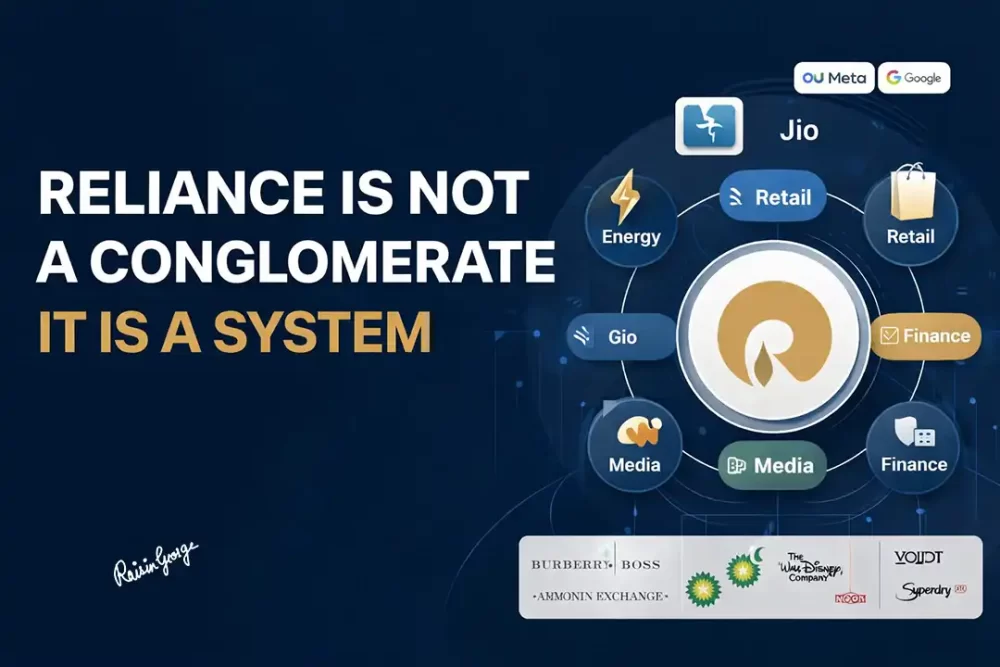
The Reliance Flywheel
If you zoom out, the model is surprisingly simple.
Energy generates capital.
Jio brings users.
Retail converts those users into customers.
Media captures their attention.
Finance captures their transactions.
And the profits go back into the system.
It is a closed loop.
Jio: The Entry Point
Jio is often seen as a telecom business. It is much more than that.
It is a user acquisition engine.
Every search, every video, every interaction creates data. That data feeds into everything else Reliance does.
Retail: Owning Distribution
Reliance Retail operates thousands of stores across India.
But the real power is control.
Control over shelf space. Control over pricing. Control over supply chains.
From AJIO to JioMart to Netmeds, the ecosystem is deeply connected.
From Distributor to Brand Owner
There is a shift happening.
Reliance is moving from selling other brands to building its own.
The relaunch of Campa Cola is one example.
When you control distribution, you control what wins.
Media: Owning Attention
Through Network18, Viacom18, and JioCinema, Reliance controls what millions watch.
Streaming IPL for free brought massive attention into its ecosystem.
Attention becomes data. Data becomes monetisation.
Finance: Closing the Loop
Jio Financial Services builds on top of everything else.
Once you understand users and their behaviour, financial products become a natural extension.
Control Without Ownership
Reliance does not always need to own everything.
It partners. It invests. It distributes.
The outcome is the same. Control where it matters.
India Depth. Global Leverage
Reliance builds scale in India and connects globally.
Energy exports, global partnerships, and investor networks extend its reach.
The Real Advantage
Most companies build businesses.
Reliance builds connections between businesses.
The moat is not size. It is integration.
Explore the full ecosystem breakdown below
If the document does not load, click here to view it .
Please rate my work
Your page rank: