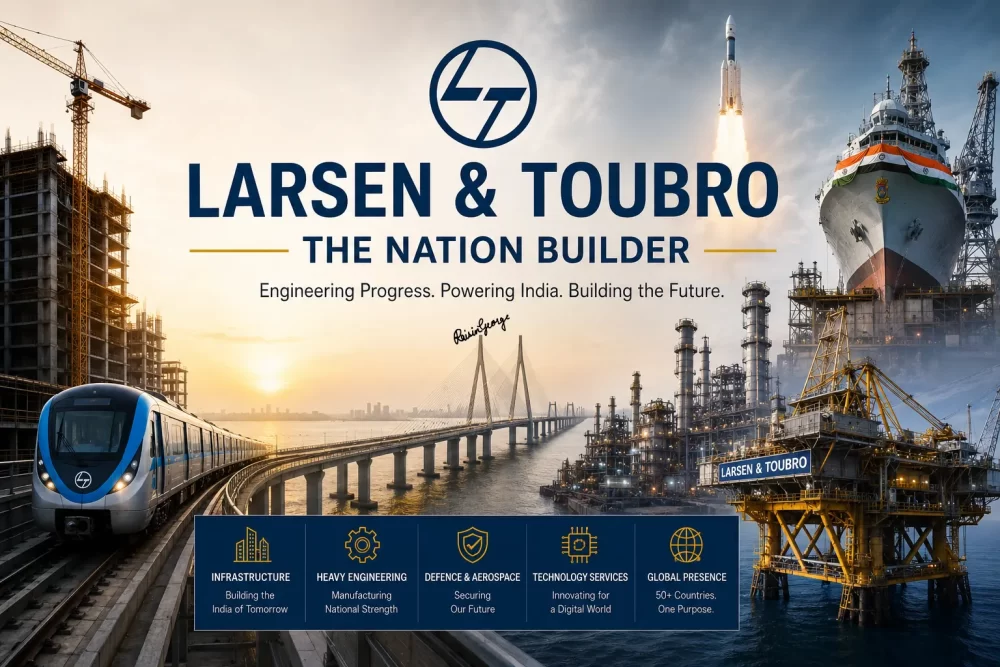
In 1938, two Danish engineers rented a tiny office in Bombay. It was so small that only one of them could sit inside at a time. Their business: representing a Copenhagen company that sold dairy equipment to Indian farms and dairies. Nobody looking at that scene would have predicted what came next.
Today, Larsen and Toubro Limited, the company those two men founded, has a contracted order book of over 6.67 lakh crore rupees. It built the hull of India's first nuclear-powered submarine. It constructed the world's tallest statue. It runs metro rail systems in over 25 Indian cities. It employs tens of thousands of engineers and operates in more than 50 countries. Half its revenue now comes from outside India.
And yet, for all its scale, L&T remains genuinely difficult to categorise. It is not just an infrastructure company. Not just a manufacturer. Not just a technology group. It is, more accurately, an engineering institution that has grown alongside India itself, solving the problems India needed solved at each stage of the country's development.
This article looks at how L&T got here, how its businesses work together, who controls it, where it makes its money, and what business leaders and students can take away from its 87-year journey. The full case study, available as a free PDF, goes considerably deeper on each of these areas. We will point you to it as we go.
L&T at a Glance
| Item | Detail |
|---|---|
| Founded | 1938 (oral agreement); formally incorporated 7 February 1946 |
| Founders | Henning Holck-Larsen and Søren Kristian Toubro (both Danish engineers) |
| Headquarters | Mumbai, Maharashtra, India |
| Core businesses | Infrastructure and construction, heavy engineering, hydrocarbon and energy, defence and aerospace, IT services (LTIMindtree, LTTS), financial services, real estate |
| Revenue (FY2025) | Over Rs 2.55 lakh crore (~$30 billion USD) |
| Order book (Q2 FY2026) | Rs 6.67 lakh crore (~$80 billion): approximately 3x annual revenue |
| Global presence | 50+ countries; 50% of revenues from international markets (FY2025) |
| Key listed subsidiaries | LTIMindtree, L&T Technology Services (LTTS), L&T Finance |
| Ownership model | No promoter family. Widely held. Professionally managed. Major shareholders include LIC, institutional investors, and the L&T Employees' Trust. |
| Why it matters | India's largest private engineering and construction conglomerate. A private-sector contributor to India's nuclear programme, space programme, and strategic defence capability. A model of professional management in Indian corporate history. |
The Origin: How Two Danes Built India's Engineering Backbone
Henning Holck-Larsen arrived in India in 1937. He was a chemical engineer from Copenhagen, working for F.L. Smidth and Company, a Danish industrial equipment firm. His colleague Søren Kristian Toubro had arrived three years earlier, in 1934, to commission cement plants in Tamil Nadu and what is now Pakistan.
While in Bombay, Toubro read a newspaper quote from Mahatma Gandhi: "I am not leading a movement to rid India of its white colonial masters in order to substitute them with brown ones." Toubro took this as a signal. An independent India, he concluded, would reward anyone who brought genuine technical skill and modern management to its industries.
The two men met up during a holiday in Matheran, a hill station near Bombay, in 1938. Over conversation, they made an oral agreement to go into business together. Their characters were opposite in useful ways: Holck-Larsen was a risk-taker who pushed for new opportunities; Toubro was methodical, precise, and conservative. That combination shaped the company's culture for decades.
The first pivot: When Germany invaded Denmark in April 1940, L&T's import business collapsed overnight. Supplies from Copenhagen stopped. Rather than fold, the two founders set up a small workshop, started servicing existing dairy equipment, and began manufacturing components themselves. It was the first of many pivots that defined L&T's character.
Wartime Bombay opened unexpected doors. Ships in the harbour needed repair and refitting. L&T formed a separate company, Hilda Ltd., to handle this work. Then came a more consequential opportunity. German engineers who had been contracted to build a soda ash plant for the Tatas were interned by British authorities due to wartime suspicions. L&T stepped in, completed the plant, and won its first major industrial construction contract.
By 1944, L&T had set up a dedicated construction entity called Engineering Construction and Contracts Ltd. (ECC). In 1945, it signed an agreement with Caterpillar Tractor Company of the USA to sell earthmoving equipment. When the war ended, surplus Caterpillar machines became available cheaply. To buy them, L&T needed fresh capital. The partners raised equity, incorporated the company formally on 7 February 1946, and listed it on Indian stock exchanges in 1950.
From trading dairy equipment to public listing: twelve years. From that listing to building India's nuclear submarine hull: another six decades of steady, often overlooked, expansion.
How L&T Evolved: Key Turning Points
Most companies have a few key moments that determined everything. L&T has many. The ones listed below are the ones that genuinely changed the company's direction, not just its size.
L&T's Business Structure: What It Actually Owns and Operates
L&T is a conglomerate, but not a shapeless one. Every major business within the group was added for a reason: either it addressed a client need that the existing business already served, or it provided a financial profile (recurring revenue, higher margins) that balanced the lumpy cash flows of large construction contracts.
The parent company, Larsen and Toubro Limited, is listed on both BSE and NSE. It directly operates the core engineering and construction businesses. It also holds controlling stakes in separately listed subsidiaries for technology and financial services.
| Business Vertical | What It Does | Why It Matters to L&T |
|---|---|---|
| L&T Construction | EPC contracts for roads, metros, airports, buildings, water systems, power grids, factories | Largest revenue contributor (~62% of group). The execution engine for India's infrastructure programme. |
| Heavy Engineering | Custom-built pressure vessels, heat exchangers, reactors for nuclear, hydrocarbon, and process industries | Capability that is genuinely hard to replicate. Nuclear-grade manufacturing requires certifications and expertise built over decades. |
| Hydrocarbon and Energy | Offshore and onshore EPC for oil and gas, refineries, petrochemicals, offshore wind, green hydrogen | Most globally intensive division. Middle East drives a large share of international revenue. |
| Defence and Aerospace | Warships, submarines, artillery systems, missile development (via JV with MBDA), ISRO hardware | India's largest private-sector defence manufacturer by revenue. Decades of relationship with DRDO and ISRO built this moat. |
| LTIMindtree (listed) | IT services: digital transformation, cloud, analytics, ERP for global enterprise clients | India's sixth largest IT company. High-margin, recurring revenue. Balances cyclicality of construction. |
| L&T Technology Services / LTTS (listed) | Engineering R&D services: automotive, aerospace, medical devices, industrial embedded systems | Different from IT services: helps companies design products, not run business systems. Strong global client base. |
| L&T Finance (listed) | NBFC serving rural borrowers, urban home loans, SME working capital; 97% retailised book | Originally created to finance construction equipment buyers. Now a standalone retail financial services business. |
| L&T Realty | Residential and commercial real estate development in Mumbai, Bengaluru, Chennai, Delhi-NCR | 70 million sq ft of development potential. L&T's brand commands a price premium in residential sales. |
| L&T Cloudfiniti / SuFin / Semiconductor | Data centres, cloud services, B2B industrial marketplace, fabless chip design | Early-stage bets on digital infrastructure. Signal that L&T is moving up the technology value chain. |
Mix
- Infrastructure Projects 62%
- Energy & Hydrocarbon 15%
- IT & Technology Services 10%
- Hi-Tech Mfg & Defence 8%
- Financial Services 3%
- Realty & Other 2%
Sector Deep Dives: What Each Business Actually Does
Infrastructure and Construction
This is where L&T earns most of its money. The construction division, now formally called L&T Construction, handles EPC contracts for roads, bridges, metro rail systems, airports, water treatment plants, power substations, hospitals, and commercial buildings. It operates across every major Indian state and is active in the Middle East and parts of Africa.
L&T's advantage here is not primarily price. It is reliability. When a state government or a large industrial group awards a project worth several thousand crore rupees, the decision-maker is asking: who will actually deliver this, on time, without a major dispute, at the contracted price? L&T answers that question more convincingly than most competitors. That reputation, built over eight decades, is worth more than any individual contract.
India's government capital expenditure has been rising sharply. The central budget has allocated over Rs 10 lakh crore for infrastructure in recent years, covering roads, railways, metros, ports, and urban development. L&T is the principal private-sector beneficiary of this cycle.
Heavy Engineering and Manufacturing
L&T's heavy engineering division makes things that almost nobody else in India can make. We are talking about massive pressure vessels for nuclear power plants, custom-built reactor columns for refineries, and specialised heat exchangers for offshore oil and gas platforms. These components are designed to specification, fabricated using specialised materials, and certified to regulatory standards that take years to achieve.
The joint venture with the Nuclear Power Corporation of India, called L&T Special Steels and Heavy Forgings (LTSSHF), can produce single forgings weighing up to 120 metric tonnes. It is the only facility of its kind in India. For India's expanding nuclear power programme, this is not just commercially important. It is strategically essential.
Energy and Hydrocarbon
L&T's hydrocarbon business provides full EPC services for the oil and gas sector: onshore processing plants, refineries, petrochemical complexes, and increasingly, offshore platforms and offshore wind foundations. It has built refineries for Indian Oil, Bharat Petroleum, and ONGC domestically, and has a strong portfolio of projects across Saudi Arabia, Qatar, Oman, Kuwait, and the UAE.
The biggest recent signal of L&T's scale in this space: a $4 billion contract from QatarEnergy LNG, won in March 2025, for offshore compression facilities. It is the largest single order the company has ever received. L&T is also building a green energy portfolio covering hydrogen electrolysers, offshore wind EPC, and small modular reactor engineering.
Defence and Aerospace
L&T entered the defence sector in 1985 through a partnership with DRDO, at a time when the government did not allow private companies to manufacture defence equipment. For nearly 20 years, L&T participated in design and development work without being able to produce. It did this deliberately, building technical knowledge, relationships, and infrastructure for a future it expected to arrive.
By 2024, L&T was India's largest private-sector defence manufacturer by revenue. It makes artillery systems, naval vessels, Coast Guard boats, missile systems through its JV with European missile company MBDA, and space hardware for ISRO. Its Hazira facility built the hull sections for INS Arihant, India's first nuclear-powered ballistic missile submarine.
Technology Services
When L&T first entered IT services in the 1990s, many analysts did not understand why a construction company would do this. The reasoning was straightforward: construction is capital-intensive, lumpy, and cyclical. IT services are recurring, capital-light, and higher-margin. Adding technology businesses smoothed the group's overall financial profile and lifted average returns.
LTIMindtree, created through the hostile acquisition of Mindtree in 2019 and its subsequent merger with L&T Infotech in 2022, is now India's sixth largest IT services company. L&T Technology Services (LTTS) is a different proposition: it is an engineering R&D services company, helping clients in aerospace, automotive, medical devices, and industrial sectors design their products and technical systems. Both are listed separately from the parent.
Financial Services
L&T Finance was created in 1994, originally to provide financing for buyers of construction equipment. It has since grown into a broader NBFC offering rural loans, home finance, and SME working capital. The company carries a domestic AAA rating and has deliberately shifted its portfolio to 97% retail loans, reducing exposure to large corporate and infrastructure loans that created difficulties during the 2018-2019 NBFC sector crisis.
Real Estate
L&T Realty develops residential and commercial property, with a development pipeline of approximately 70 million square feet across Mumbai, Bengaluru, Chennai, and Delhi-NCR. The brand premium is real: L&T's name on a residential project signals on-time delivery and construction quality in a market where both are frequently absent. The Hyderabad Metro concession gave L&T rights to develop real estate around station areas, combining infrastructure and property development in a single project.
Not a Random Conglomerate: How L&T's Businesses Feed Each Other
Most large conglomerates are assembled over time and held together by a common balance sheet and ownership structure. L&T is different. Its businesses share capabilities, clients, talent, and reputation in ways that create genuine competitive advantages, not just financial diversification.
L&T Core Foundation
Engineering DNA | Procurement Scale | 87 Years of Trust | Project Management Culture
Construction
Uses heavy engineering output, BIM from LTTS, finance from L&T Finance for equipment loans
Feeds: Energy, Defence, RealtyHeavy Engineering
Nuclear forgings and pressure vessels support both hydrocarbon EPC and defence manufacturing
Feeds: Hydrocarbon, Defence, NuclearHydrocarbon / Energy
Shares engineering design teams, procurement scale, and project managers with construction
Feeds: Middle East growth, Green energyDefence and Aerospace
Draws on metallurgy and manufacturing from heavy engineering; ISRO and DRDO relationships are long-standing
Feeds: National strategic valueLTIMindtree / LTTS
Technology credibility improves L&T's EPC bids; digital tools used across construction and industrial projects
Feeds: Margin improvement, Global scaleFinance and Realty
L&T Finance funds equipment buyers in L&T's contractor base; Realty piggybacks on metro concessions and construction infrastructure
Feeds: Ecosystem stickinessConsider a concrete example. When L&T builds a metro rail system, its construction division handles civil and structural work. Its technology divisions supply digital systems: project monitoring platforms, BIM models, sensor networks. Its real estate arm develops commercial and residential property around the metro stations. Its finance arm can provide working capital to subcontractors. The brand name on the project reassures real estate buyers that the buildings will be delivered.
Or consider the defence-heavy engineering link. The same metallurgical expertise used to produce nuclear-grade forgings at the LTSSHF facility is applied to naval armour plating and submarine hull sections. The quality certifications built for AERB (Atomic Energy Regulatory Board) compliance exceed most defence requirements. L&T's defence division inherited decades of investment in manufacturing infrastructure that was originally built for nuclear and hydrocarbon clients.
The brand as synergy: L&T's name is a credibility signal across every business. Its real estate projects sell faster than competitors. Its NBFC raises cheaper capital than standalone NBFCs because the parent balance sheet implies support. LTIMindtree wins enterprise deals partly because clients associate L&T with engineering discipline and delivery. The brand does not just represent a company. It represents a track record spanning eight decades.
Ownership Without a Family: L&T's Unusual Corporate Structure
In India's corporate landscape, almost every large company is controlled by a founding family. Reliance has the Ambanis. Tata Sons has the Tata Trust. Bajaj, Godrej, Mahindra, Birla: all have families at the helm. L&T has no promoter family at all. Zero promoter holding. This is genuinely unusual, and understanding why it works requires knowing how the company arrived here.
The founders, Holck-Larsen and Toubro, made a deliberate choice. They did not install family members as successors. Toubro retired from active management in 1962-63. Holck-Larsen retired as Chairman in 1978. Both left without creating a succession dynasty. The company passed into the hands of professional managers and institutional shareholders.
Who Owns L&T Today
| Shareholder Category | Approximate Stake |
|---|---|
| Life Insurance Corporation of India (LIC) | ~14-15% |
| L&T Employees' Trust / Welfare Foundation | ~12-13% |
| Foreign Institutional Investors | ~22-25% |
| Domestic Mutual Funds and Insurance Companies | ~18-20% |
| Retail and Public Shareholders | ~15-18% |
| Other Domestic Institutions | ~5-8% |
The Employee Trust is particularly important. It was created in 2003 as part of the resolution of the Birla takeover attempt. When Birla agreed to sell its stake back to L&T, the stake went to the Employee Trust rather than to any single external buyer. This created a block of approximately 12-13% that would never support a hostile acquirer, because the employees themselves benefited from the company remaining independent and professionally managed.
The ESOP Factor
In 2006, under A.M. Naik's leadership, L&T became the first non-IT, non-finance Indian company to issue ESOPs to a large workforce. Thousands of engineers and managers received shares. The result was a cultural shift: employees began checking L&T's share price because they owned stock. Project managers started thinking about capital efficiency. Senior executives made investment decisions knowing their own financial outcomes were tied to the company's performance.
Why this is unusual in India: Most Indian conglomerates have family promoters who hold 40-70% of the company and make decisions accordingly. In the absence of a promoter, L&T has had to substitute family discipline with institutional governance, meritocratic management, and employee ownership. That it has done this successfully for 47 years since the founders retired is arguably its most underappreciated achievement.
Risks of the Model
Professional management without a promoter carries its own vulnerabilities. Nobody has their own wealth so thoroughly at stake that they will defend the company unconditionally in a crisis. Management succession is harder: without a family, the next leader must be groomed over decades through the system, which requires long-term planning and can create uncertainty. And dispersed institutional ownership can create short-term pressure from shareholders who want quarterly results rather than decade-long capability building.
India and the World: How L&T's Revenue Geography Has Shifted
Ten years ago, L&T earned roughly two-thirds of its revenue inside India. Today, it earns half from international markets, and that share is still rising. This is not coincidence. It is the result of deliberate decisions taken over two decades to build capability in the Middle East, Southeast Asia, and Africa.
The Middle East is L&T's most important international geography. As of March 2025, roughly 37% of the total group order book came from the GCC region. Saudi Arabia's Vision 2030 construction drive, Qatar's LNG expansion, UAE's power grid modernisation, and Oman's water infrastructure have all generated large contracts for L&T. The company has been operating in the Middle East since 1976, which means it has the ground relationships, local offices, and cultural familiarity that a new entrant simply cannot replicate quickly.
LTIMindtree and L&T Technology Services operate at the other end of the international spectrum. Their clients are primarily Western corporations: North American banks, European automotive manufacturers, global aerospace companies, US-based healthcare firms. Their revenues are predominantly in US dollars and euros.
This dual international exposure serves L&T well. When the Middle East market slows (due to oil price cycles or geopolitical disruption), technology services continue generating stable, dollar-denominated revenue. When technology sector spending contracts, Middle East infrastructure projects are typically unaffected.
The Risks of International Scale
Scale in international markets brings its own complications. Geopolitical volatility in the Middle East, the Houthi attacks on Red Sea shipping, currency fluctuations, and local content requirements in international tenders all add execution complexity. Projects in unfamiliar geographies carry higher risk than domestic work. Payment cycles on international projects, particularly large government-sponsored contracts, can stretch to 18-24 months.
How L&T Makes Money: The Business Model Explained Simply
L&T does not have a single revenue model. Across its businesses, it earns money in fundamentally different ways. Understanding this mix is key to understanding why the company's overall financial profile is more stable than any single business within it.
| Business Type | How Revenue Is Generated | Margin Profile |
|---|---|---|
| EPC Construction | Milestone-based billing over multi-year contracts | 7-10% EBIT; thin but stable |
| Heavy Engineering | Order-based; custom-fabricated equipment sold to clients | 10-15% EBIT; higher due to complexity and scarcity |
| Hydrocarbon EPC | Similar to construction; international projects often USD-denominated | 8-12% EBIT; varies by project complexity |
| Defence Manufacturing | Government milestone contracts; often multi-year programmes | 12-18% EBIT estimated; protected by limited competition |
| IT Services (LTIMindtree) | Time-and-materials or fixed-price; largely recurring | 18-22% EBIT; high-margin, asset-light |
| ER&D Services (LTTS) | Project-based or retainer-based engineering services | 18-22% EBIT; premium for specialised engineering knowledge |
| Financial Services | Net interest income on loan book | ROE target 12-15%; capital-intensive |
| Real Estate | Sales of residential units; commercial lease income | Project-specific; premium brand allows pricing above market |
The Order Book: Why This Number Matters More Than Quarterly Revenue
Most companies report what they earned last quarter. L&T reports what it has already agreed to earn over the next 2-4 years. That number, the order book, is the single most important indicator of the company's financial health.
As of Q2 FY2026, L&T's consolidated order book stood at Rs 6.67 lakh crore. Its annual revenue in FY2025 was roughly Rs 2.55 lakh crore. Put differently: L&T has approximately 2.5 to 3 years of future revenue already contracted and sitting on its books. Most businesses would consider six months of forward visibility excellent. L&T operates with years of it.
Why this matters for investors and clients alike: A large, growing order book means revenue growth is visible before it arrives. It means the company can plan hiring, equipment, and supply chain with confidence. It means clients are not just happy with past work but trusting L&T with future work. A declining order book, on the other hand, is an early warning signal that future growth will disappoint. Watching L&T's quarterly order inflows is therefore more revealing than watching quarterly profits.
Why L&T's Model Has Survived Eight Decades
L&T has outlasted economic crises, hostile acquirers, technology disruptions, government policy shifts, and global market cycles. This does not happen by accident. Here are the structural reasons the model has held.
Trust Is Quantifiable
L&T wins contracts at margins 5-15% higher than competitors in many categories because clients pay for certainty. An on-time, on-budget track record across eight decades is a financial asset, not just a reputation.
Engineering Depth Is a Moat
L&T can design, manufacture, and execute things most competitors cannot. Nuclear forgings, nuclear submarine hulls, offshore compression platforms: these require decades of capability-building that cannot be acquired quickly.
Diversification That Actually Works
L&T's businesses share talent, procurement, technology, and client relationships. Diversification here adds competitive strength rather than diluting management attention.
National Indispensability
When a country's nuclear triad, metro rail network, and space programme all pass through one private company, that company is not easy to replace. L&T has positioned itself as institutionally essential.
Professional Management That Has Actually Worked
No family conflicts. No nepotism at the top. No promoter extraction of capital. The meritocratic culture attracts India's best engineers, who in turn sustain the technical capability that generates the trust.
The Order Book Model
Multi-year revenue visibility allows disciplined planning. L&T does not need to win new business every quarter to sustain operations. This provides financial resilience that pure service businesses rarely have.
Where L&T Can Go Wrong: Risks and Challenges
A good analysis of L&T requires acknowledging what could hurt it. The company is well-managed, but it faces structural challenges that professional management alone cannot fully resolve.
| Risk | Why It Matters | How L&T Manages It |
|---|---|---|
| Government capex dependence | A significant share of L&T's Indian order book comes from government-funded projects. Election cycles, fiscal consolidation, or policy shifts can delay project awards. | International expansion; growing private sector exposure; Middle East pipeline provides counter-cyclical revenue. |
| Project delays and cost overruns | Long-duration EPC contracts are exposed to design changes, ground conditions, regulatory approvals, and subcontractor failures. Each delay reduces margin and increases working capital pressure. | Stage-gate project management; conservative bid estimation; escalation clauses in contracts. |
| Working capital pressure | L&T spends cash months before it bills clients. As revenues grow, the absolute working capital requirement grows with them. | Mobilisation advances; letter-of-credit facilities; strong bank relationships from investment-grade rating. |
| Commodity price volatility | Steel, copper, cement, and fuel prices directly affect EPC project margins. A commodity spike can turn a profitable contract into a loss-making one. | Back-to-back price escalation clauses; hedging instruments; procurement scale reduces unit costs. |
| Middle East geopolitical risk | 37% of the order book is in the GCC. Regional instability, oil price crashes, or conflict can freeze project spending quickly. | Long-standing sovereign client relationships; revenue from multiple GCC countries spreads country risk. |
| EPC margin pressure | Construction EPC margins are structurally thin. Aggressive bidding by domestic and global competitors makes it hard to improve margin without winning higher-complexity work. | Shift toward defence, green energy, data centres, and other higher-margin categories. |
| Technology disruption | AI-assisted project management, autonomous construction equipment, and modular prefabrication could commoditise parts of L&T's construction advantage over a 10-20 year horizon. | Investment in BIM, digital construction, and AI tools; own technology businesses (LTTS, LTIMindtree) create familiarity with disruption. |
| Talent retention | Senior engineers and project managers are in high demand globally. Retaining them in a meritocratic culture requires sustained investment. | ESOPs; L&T Engineering College; internal mobility across businesses and geographies. |
| Conglomerate complexity | Managing 93+ subsidiaries and 27+ joint ventures creates governance overhead. Capital allocation decisions across such diversity are genuinely difficult. | Decentralised business unit leadership; independently listed subsidiaries with their own governance. |
| ESG and environmental exposure | Large infrastructure projects face environmental litigation. The hydrocarbon business is carbon-intensive. Investor ESG screens could become a valuation headwind. | Green energy portfolio expansion; sustainability reporting; Mission Zero Harm safety programme. |
Lesser-Known Facts About Larsen and Toubro
Beyond the financial headlines and project announcements, L&T's history contains details that most people, even those who follow the company closely, do not know.
The Handshake Company
L&T was founded through an oral agreement in 1938. The two founders shook hands on the deal during a hill-station holiday. The formal legal incorporation came eight years later, in 1946.
The Nuclear Submarine Nobody Talks About
L&T's Hazira facility fabricated hull sections for INS Arihant, India's first nuclear-powered ballistic missile submarine, commissioned in 2016. L&T is described as the single largest contributor to the programme. When India completed its nuclear triad, L&T was a key reason why.
Bhabha Came to Them
Dr. Homi Bhabha, the father of India's nuclear programme, personally approached L&T in the 1950s to fabricate critical reactor components. The relationship between L&T and India's nuclear establishment was initiated by one of the country's greatest scientists, not by a government tender.
ISRO's Original Private Partner
Vikram Sarabhai, ISRO's founder, personally designated L&T as a manufacturing partner for space hardware in the 1970s. The relationship has deepened continuously since. L&T now fabricates cryogenic engine components and launch vehicle structures.
Three Takeovers, All Repelled
Between 1987 and 2003, L&T faced hostile acquisition attempts from Manohar Chhabria, Dhirubhai Ambani, and Kumar Mangalam Birla. All three failed. The resolution of the Birla attempt produced UltraTech Cement, now India's largest cement company, as a side effect of L&T defending its independence.
First Non-IT ESOP in India
In 2006, L&T became the first non-IT, non-finance Indian company to issue ESOPs at scale. AM Naik's goal was partly to align employee incentives, and partly to turn employees into a shareholder base that would be difficult for any future acquirer to coopt.
120-Tonne Forgings
The L&T-NPCIL joint venture, LTSSHF, can produce individual steel forgings weighing up to 120 metric tonnes. It is the only facility of its kind in India. Nuclear power plant components, steam generators, and turbine shafts are made here.
The Statue, Ahead of Schedule
L&T built the Statue of Unity, the world's tallest at 182 metres, and completed it nine months ahead of the 42-month contractual schedule. It used BIM technology coordinating 30 global consultants simultaneously, and incorporated two 200-tonne tuned mass dampers to stabilise the structure against wind and seismic activity.
One Office, Two Founders, One at a Time
L&T's first office in Bombay was so small that only one of the two founders could be inside at any moment. The other waited outside. That office was the starting point for a company that now has an order book roughly equivalent to a third of India's annual government budget.
Holck-Larsen Gave Up His Passport
Henning Holck-Larsen renounced his Danish citizenship and became an Indian citizen in 1950. He described India as his "adopted homeland." He received the Ramon Magsaysay Award, sometimes called the Asian Nobel Prize, in 1976 for his contribution to India's industrial development.
Read the Full L&T Case Study
This article covers the key facts and analysis, but the full case study goes significantly deeper. The PDF, available free at the link below, is a comprehensive research document written in a business case study format. It covers:
- The complete origin story and founding values in depth
- A detailed timeline of 40+ milestones from 1938 to 2026
- In-depth sector analysis of each business vertical with margin data
- The full governance and ownership analysis, including the ESOP model
- The Mindtree hostile takeover, examined as a corporate strategy case
- Strategic analysis of how L&T's businesses interconnect
- Risks examined in depth, including working capital and technology disruption
- Iconic project case studies: INS Arihant, Statue of Unity, Mumbai Trans Harbour Link, QatarEnergy LNG
- Strategic lessons for founders and business leaders
- A final analysis section answering what defines L&T's next decade
Larsen and Toubro: The Nation Builder
A free, deeply researched business case study. Full analysis of L&T's history, structure, business model, strategy, and leadership. No registration required.
Read the Full Case Study (Free PDF)Preview the PDF
If the preview is not loading, click here to open the PDF directly.
Final Takeaway: What L&T Teaches Us
Larsen and Toubro is not interesting because it is large. It is interesting because of how it got large, who controls it, and what it has built along the way.
Most great companies are built around a brilliant founder, a family dynasty, or a category-defining product. L&T has none of these. It was built by two quiet Danes who adapted to every external disruption, chose not to build a family empire, and instead created an institution that outlasted them by decades and counting.
What makes L&T different from other Indian conglomerates is the combination of things it has simultaneously managed to get right: engineering seriousness, professional governance, strategic patience (thirty years of DRDO work before a single defence production order), connected diversification, and a rare willingness to divest rather than accumulate for its own sake. Selling the cement business in 2004 was not a retreat. It was a disciplined choice that removed a non-core distraction and solved a governance crisis in one move.
For India, L&T matters because large, complex, strategically important projects cannot be delivered by weak institutions. The nuclear triad needed a fabrication partner with decades of precision manufacturing experience. The metro systems needed a builder with the balance sheet to handle billion-rupee contracts. The Middle East energy market needed an EPC firm that could compete with global players and win. L&T was at the intersection of all of these needs, not by accident but because it had been investing in the right capabilities for decades before those needs arrived.
For business leaders, the L&T case study offers lessons that do not fit on a slide: trust takes generations to build and one bad contract to damage; diversification only works if the businesses genuinely share something; professional management can outperform family control when governance is serious; and sometimes the best strategic move is to give something away in order to keep what matters most.
Key Lessons From the L&T Story
- Adversity can be a capability-building opportunity, if you choose to treat it that way
- Trust is a financial asset, not a soft value. It compounds over decades and commands pricing premiums
- Diversify along competency lines, not along opportunity lines
- Employees who are also shareholders make better long-term decisions
- Becoming indispensable to the national interest creates business security that no marketing can replicate
- The order book is the real measure of a capital-intensive business, not this quarter's profit
- Professional management can work without a promoter, but only with genuine governance discipline and strong incentive alignment
The full case study covers all of this in significantly greater depth, including leadership analysis, iconic project case studies, financial model breakdown, and a strategic lesson framework. If you found this article useful, the PDF will repay several hours of reading.
Read the Full Case Study: Free PDF
87 years of history, business model analysis, sector deep dives, lesser-known facts, strategic lessons and a final analysis. Written for business readers, students and founders.
Download the Free L&T Case StudyPlease rate my work
Your page rank: