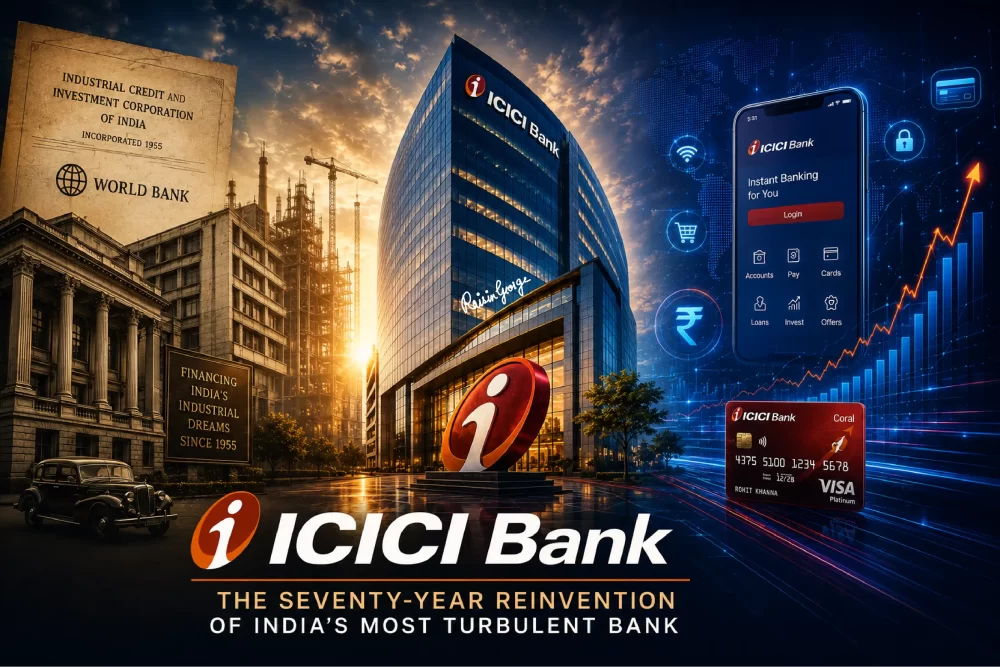
ICICI Bank: From World Bank Mandate to Digital Colossus
The Seventy-Year Reinvention of India's Most Turbulent Bank
The Bank That Should Not Exist
Every Indian knows ICICI Bank. Hundreds of millions use its app, carry its credit card, or repay its home loan. It is the country's second-largest private sector bank, with over ₹26 lakh crore in consolidated assets and a profit after tax of ₹47,227 crore in FY2025.
But ICICI Bank should not exist. Not in its current form. Not under its current name. And not without a sequence of near-death experiences, governance scandals, and institutional reinventions so dramatic that the bank standing today barely resembles the institution incorporated in 1955.
The real story of ICICI Bank is not the story of a bank that was built. It is the story of a bank that kept rebuilding itself — sometimes brilliantly, sometimes recklessly — while India's economy transformed around it.
In less than a decade, there have been two credit cycles where ICICI Bank has been caught on the wrong foot. That is why investor confidence seems low.
— Senior analyst at a foreign brokerage, 2016One Institution, Three Complete Reinventions
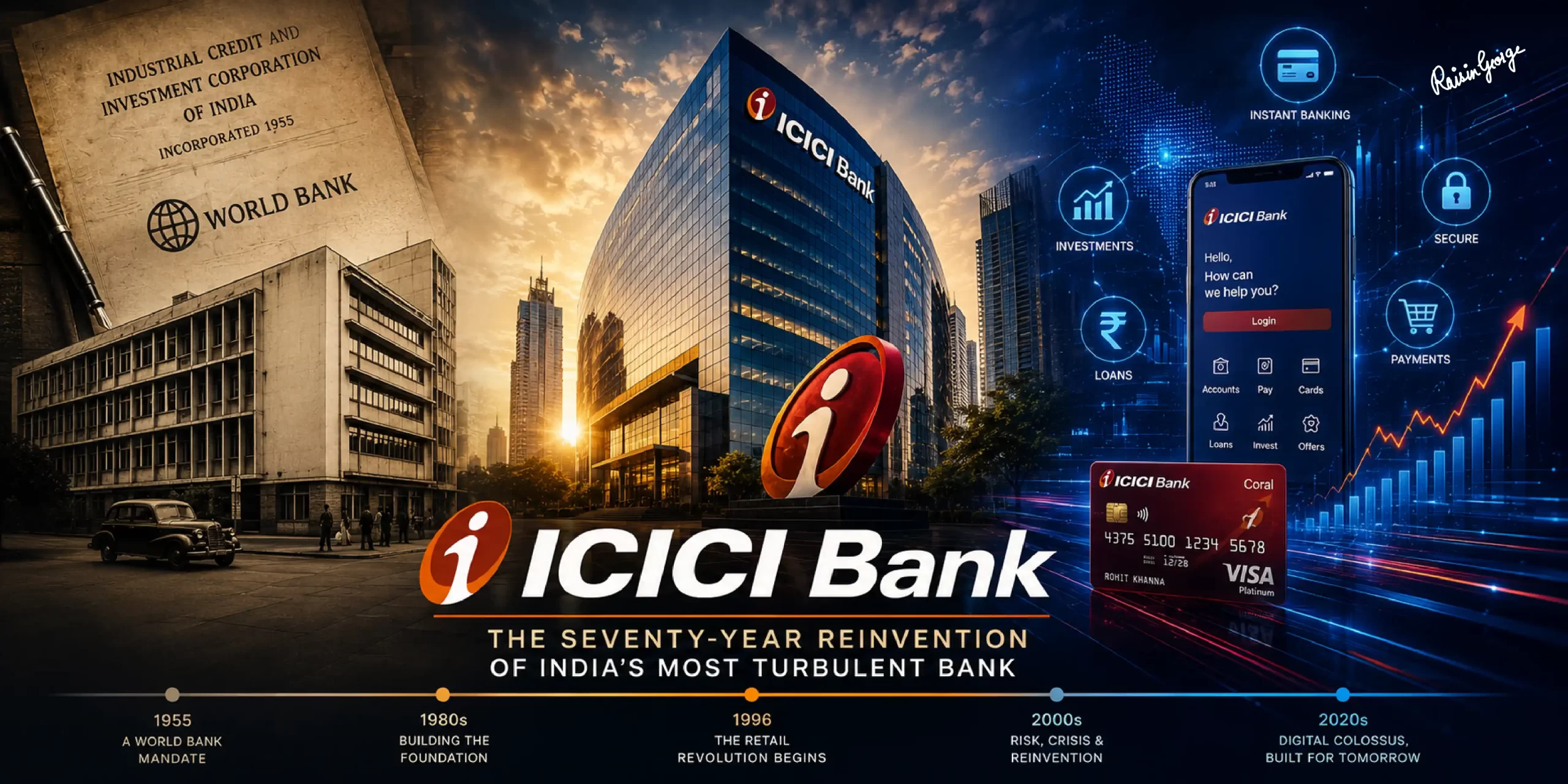
The Development Era: Born from a Cold War Brief
ICICI was not founded by a visionary entrepreneur. It was founded by a geopolitical calculation. In 1955, the World Bank and the Government of India identified a structural gap in India's capital markets: no institution existed to provide medium and long-term financing to Indian industry. The Development Financial Institution model — tested in post-war Germany and Japan — was the answer.
The Industrial Credit and Investment Corporation of India was incorporated on January 5, 1955, with seed capital from the World Bank, the Government of India, Indian public sector banks, and insurance companies. Sir Arcot Ramasamy Mudaliar became its first Chairman.
For 30 years, ICICI was invisible to consumers. It financed steel plants, cement factories, petrochemical complexes, and automotive facilities — a machine channelling long-term capital into the arteries of a planned economy. Ordinary Indians had no idea it existed.
N. Vaghul and the Financial Supermarket
The pivotal inflection point arrived in 1985, when N. Vaghul — who had become the youngest Chairman of a state-run bank at 44 — joined ICICI as its seventh Chairman and Managing Director. Vaghul conceived the "Financial Supermarket": one institution serving customers across the full spectrum of financial need.
Under Vaghul through the late 1980s, ICICI launched a venture capital arm (TDICI, now ICICI Venture), moved into leasing, and began assembling the diversified services group that would later define it. He also recruited a young IIM Ahmedabad graduate named Kundapur Vaman Kamath — and extracted a promise before he left for the Asian Development Bank in 1988: return when needed.
Vaghul laid the foundation that made him known as the man who introduced the concept of Financial Supermarkets to India.
— Business StandardThe Structural Problem That Would Not Wait
By the early 1990s, India's liberalisation of 1991 had changed everything. As corporations accessed capital markets directly — through commercial paper, bonds, equity — they no longer needed ICICI's expensive, long-tenure project finance loans. The asset-liability mismatch was creating a slow-motion crisis. ICICI had to transform, fundamentally and urgently, or become irrelevant.
The Kamath Era: EMI Revolution and Universal Banking
The Return of the Prodigal Banker
In 1996, Vaghul called in the promise. Kamath returned from the Asian Development Bank and became MD and CEO of ICICI. He arrived with a clarity of vision that was almost violent in its simplicity: ICICI had to stop being a development finance institution and become a retail bank. Not gradually. Now.
His 90-day rule became legendary: any project that could not be launched within three months of conception was to be abandoned. This velocity philosophy — unlike anything in Indian banking culture — would drive ICICI's transformation.
The 90-Day Rule
Projects not deliverable within 90 days were abandoned. Kamath believed the external environment changed too fast for slower timelines.
ATMs in Year One
Deployed 1,000 ATMs when fewer than 100 existed in all of India. Then invented ATM-on-Wheels for underserved areas.
The Floating Rate Loan
First in India to offer floating-rate home loans. Lower initial EMI. Wider market access. Now the industry standard across India.
The EMI Revolution: Rewriting India's Relationship with Money
Kamath's single most consequential decision was the democratisation of the equated monthly instalment. Before ICICI's retail push, home loans in India were predominantly fixed-rate products for government employees and the upper middle class. ICICI Bank, under Kamath and Chanda Kochhar — who was architecting the retail strategy alongside him — changed three things simultaneously:
First, floating-rate home loans, making ICICI the first lender in India to offer this instrument. Second, Direct Selling Agents — a field sales force that went to customers rather than waiting. Third, a 1,000-ATM rollout in year one, then the Mobile ATM to serve areas without fixed infrastructure.
He introduced India to the EMI culture — a disruptive change that realised the aspirations of the growing middle class. In just three years, the bank became the market leader in retail credit.
— Business StandardThe Reverse Merger: A Subsidiary Absorbs Its Parent
By 2001, the development finance structure was unsustainable. The solution was unprecedented in Indian corporate history: a reverse merger. Parent company ICICI Ltd would merge into its banking subsidiary, ICICI Bank. The subsidiary would adopt the parent's identity.
October 2001: Boards approve → January 2002: Shareholders approve → March 2002: High Court of Gujarat → April 2002: High Court of Mumbai + RBI. Completed in six months. Overnight, ICICI Bank became India's 2nd largest bank by assets — behind only SBI.
The NYSE Listing and International Expansion
In 1999, ICICI became the first Indian company and first bank from non-Japan Asia to list on the New York Stock Exchange — imposing international disclosure standards years ahead of domestic requirements. The international build-out that followed, led by Lalita Gupte, established ICICI Bank UK as the largest Indian bank in Britain with a balance sheet exceeding $8 billion, alongside operations across the US, Canada, Singapore, Bahrain, Dubai, and more than a dozen other markets. At its peak, international operations contributed 25% of the consolidated balance sheet.
Building the Subsidiary Empire
| Subsidiary | Partner | Founded | Position FY2025 |
|---|---|---|---|
| ICICI Prudential Life Insurance | Prudential (UK) | 2000 | India's largest private life insurer |
| ICICI Lombard General Insurance | Fairfax Financial (Canada) | 2001 | Leading private general insurer |
| ICICI Prudential AMC | Prudential (UK) | 1998 | India's largest AMC by AUM |
| ICICI Securities | — | 1995 | Integrated into ICICI Bank (2024) |
| ICICI Venture | — | 1988 (as TDICI) | Leading PE/VC fund manager |
The Bank Run That Almost Destroyed India's Private Banking Sector
September 15, 2008. Lehman Brothers files for bankruptcy. Within hours, SMS chains claiming ICICI Bank was exposed to Lehman and at risk of collapse circulated across India. The rumours were false — ICICI's exposure to Lehman was minimal. But the perception was irreversible.
Customers queued at ICICI ATMs and branches nationwide. The bank sent mass SMS: "Your deposits with ICICI Bank are safe... rumours are baseless and malicious." CEO KV Kamath echoed the statement. Neither was sufficient. Finance Minister Chidambaram and RBI Governor Subbarao ultimately had to intervene publicly — the RBI's credibility, not ICICI's own communication, calmed the panic.
In January 2009, Infosys — India's second-largest software exporter and presumably one of ICICI's most sophisticated corporate depositors — quietly shifted nearly its entire deposit base to State Bank of India. The message was unmistakable: even India Inc. had been rattled.
Chanda Kochhar: Icon to Accused
The Rise
When Chanda Kochhar became MD and CEO in 2009, the moment was celebrated as historic. One of the most powerful women in Indian corporate history — on every magazine cover, cited in every diversity article. Her credentials were real: she had joined ICICI in 1984, had been at the centre of every major transformation, and had architected the retail strategy alongside Kamath. She was, by any measure, the most qualified person to lead the bank she had helped create.
The Videocon Conflict of Interest
In 2012, ICICI Bank approved a ₹3,250 crore loan to Videocon Group as part of a 20-bank consortium. Chanda Kochhar chaired the credit committee. What was not disclosed: within months of the loan's disbursement, Videocon's Venugopal Dhoot invested ₹64 crore in NuPower Renewables — a company owned by Kochhar's husband, Deepak Kochhar. Kochhar had not disclosed this relationship. She had not recused herself.
| Date | Event |
|---|---|
| 2012 | ICICI sanctions ₹3,250 Cr Videocon loan; ₹64 Cr flows to Deepak Kochhar's NuPower |
| March 2018 | CBI registers preliminary enquiry; whistleblower complaint becomes public |
| April 2018 | ICICI Board issues public support statement for Kochhar — later reversed |
| May 2018 | SFIO seeks approval to probe; Kochhar goes on indefinite leave |
| June 2018 | Retired Justice Srikrishna inquiry launched; Sandeep Bakhshi appointed COO |
| July 2018 | SEBI issues show-cause notice to Kochhar |
| October 2018 | Kochhar resigns; board accepts; terminated with cause (benefits stripped) |
| December 2022 | CBI arrests Chanda Kochhar and Deepak Kochhar |
| January 2023 | Venugopal Dhoot arrested |
The Second NPA Cycle: Corporate (2015–2017)
Even before the scandal became public, ICICI's corporate book was imploding. Post-2008, the bank had pivoted to corporate and infrastructure lending — replicating the same DFI instinct that had been restructured away in 2002. When the RBI's Asset Quality Review forced recognition of hidden stressed assets in 2016, the result was catastrophic.
Q4 FY2016: Net profit collapsed 87% to ₹406 crore. Gross NPAs hit 5.82%. An analyst stated publicly: "Very unfortunately, ICICI Bank has a chequered past and has got almost every cycle wrong." In under a decade, the bank had suffered retail NPAs (2008) and corporate NPAs (2015). Both self-inflicted.
The Institution That Built Indian Finance's Leadership Pipeline
One of ICICI Bank's least-examined stories: it functioned as a graduate school for Indian private banking — and watched most of its graduates leave. Kamath's philosophy of disproportionate responsibility at young ages produced leaders at a rate no competitor matched.
ICICI Bank's talent diaspora leads major financial institutions across India. The institution built a generation of India's banking leadership — and then had to compete against them. No other Indian bank has produced comparable leadership density in the private sector.
The Bakhshi Turnaround: One Bank, One ROE
The Insider Nobody Predicted
Sandeep Bakhshi was not on any analyst's shortlist. Not a public figure. Not charismatic. What he was: an ICICI lifer since December 1986 — wholesale banking, corporate banking, SME lending, and ICICI Prudential Life Insurance, which he had turned around into India's largest private life insurer before being recalled to the bank as COO in June 2018, then CEO in October 2018.
The Un-Glamorous Philosophy That Rebuilt a Bank
Bakhshi's operating principle — "One Bank, One ROE" — reoriented the entire organisation around a single profitability metric applied uniformly. Where previous leadership managed ICICI as separate businesses optimising individual P&Ls, Bakhshi imposed return on capital as the final arbiter of every lending decision.
Special Project Finance Group
The unit responsible for concentrated corporate NPA loans was wound down. Large infrastructure bets were off the table.
Management Structure
Genuine P&L accountability to business unit heads and branch managers. Decisions moved from headquarters to the field.
Product Architecture
Reduced complexity that confused customers and created operational inefficiency. One CRM for all client touchpoints.
| Metric | FY2018 (Pre-Bakhshi) | FY2021 | FY2025 |
|---|---|---|---|
| Return on Assets | 0.43% | 1.70% | ~2.2% |
| Net NPA Ratio | 3.65% | 0.63% | ~0.4% |
| Gross NPA Ratio | ~8.8% | 4.96% | ~1.9% |
| Capital Adequacy | ~14% | ~19.6% | 16.55% |
| Net Profit (₹ Cr) | 6,777 | 16,193 | 47,227 |
| Market Cap (approx) | ~₹1.5 lakh Cr | ~₹3.7 lakh Cr | ~₹9 lakh Cr |
The Digital Transformation
Even as Bakhshi cleaned up the balance sheet, he was simultaneously executing a digital repositioning that would reshape ICICI's competitive position for the coming decade.
iMobile Pay — Open Platform
Opened to non-ICICI Bank customers. A platform decision — embedding ICICI infrastructure across a market wider than its own depositor base.
InstaBIZ for SMEs
Comprehensive business banking: loans, overdraft, export-import, tax payments, current account — from one mobile app.
4,600+ APIs
Ecosystem banking partnerships with fintechs, e-commerce platforms, and corporate ERP systems. 160M+ digital transactions per day.
ICICI Stack
Segment-specific digital ecosystems for healthcare, education, broking, and government customers. Embedded in the platforms where customers already live.
Ups and Downs: Seventy Years of Strategic Pivots
| Period | Peak Achievement | Crisis | Root Cause |
|---|---|---|---|
| 1955–1990 | DFI dominance; funded industrial India | Model obsolescence by late 1980s | Liberalisation made project finance uncompetitive |
| 1996–2007 | Kamath's EMI revolution; market leader in retail credit in 3 years | First NPA cycle building silently | DSA-driven volume without credit discipline |
| 2007–2009 | International expansion; 25% balance sheet offshore | 2008 bank run; Infosys shifts deposits | Lehman crisis + retail NPA spike |
| 2009–2015 | Post-retail stabilisation; Kochhar's corporate push | Corporate NPA crisis; 87% profit fall | RBI AQR; infrastructure loan defaults |
| 2016–2018 | Partial profit recovery | Videocon scandal; CBI investigation | Board governance failure; conflict of interest |
| 2018–2025 | Record profits; NPA cleanup; digital leadership; market cap 6x | — | One Bank One ROE; disciplined underwriting |
What Could Go Wrong
| Risk | Severity | Assessment |
|---|---|---|
| Third NPA cycle | HIGH | Credit culture reforms are recent; a macro downturn tests whether discipline has been institutionalised or just imposed by a vigilant CEO |
| CASA compression | MEDIUM | Ratio fell from 49.6% (2019) to 39.6% (2023); higher funding costs and margin pressure as depositors chase fixed deposit yields |
| Fintech and Jio disruption | MEDIUM | Jio Financial Services (with KV Kamath as Chairman) has Reliance's distribution muscle; could be a structural challenger for transactional and low-ticket credit |
| International retreat | LOW-MED | Post-2008 global retrenchment left ICICI's international ambition unresolved; whether India-centric focus is permanent or temporary remains open |
| Succession risk | MEDIUM | Next CEO transition will be watched closely given historical instability at the top; the Bakhshi culture needs a successor who preserves its discipline |
| Regulatory tightening | MEDIUM | RBI's increased risk weights on unsecured lending compresses credit card and personal loan growth — a meaningful revenue source |
Eight Things You Didn't Know About ICICI Bank
H.T. Parekh Connection
ICICI's third Chairman, H.T. Parekh, helped sponsor the formation of Housing Development Finance Corporation — the institution that became ICICI's most powerful rival for decades.
First Internet Banking in India
ICICI Bank pioneered internet banking in India in 1998 — six years before smartphones, when most Indians had no home internet access.
The Rarest Corporate Move
The 2002 reverse merger — parent absorbed into subsidiary — is one of the rarest corporate manoeuvres in Indian history. The subsidiary kept its own name.
The 8-8 Banking Concept
ICICI Bank introduced 8AM–8PM banking (all branches open Monday–Saturday) years before extended hours became industry norm in India.
ATM-on-Wheels
Invented the Mobile ATM to serve areas where fixed infrastructure was not viable — a precursor to financial inclusion thinking that preceded the Jan Dhan era by a decade.
First NYSE-Listed Asian Bank
ICICI became the first bank or financial institution from non-Japan Asia to list on the NYSE in 1999 — before China's bank listings, before any other Asian emerging market institution.
The Leadership Factory
Current or recent heads of IDFC First, Axis Bank, Goldman Sachs India, and JP Morgan India all came from ICICI Bank. No other Indian institution has produced comparable banking leadership density.
KV Kamath Now at Jio
KV Kamath — the man who built ICICI into India's largest private bank — is now Chairman of Jio Financial Services, ICICI's potential structural challenger backed by Reliance's distribution.
What ICICI Bank Teaches Business
1. Structural obsolescence is survivable — if recognised early
ICICI's development finance model was dying by 1990. The institutions that survived liberalisation recognised this and transformed aggressively. Those that didn't became irrelevant. Speed of self-recognition is an existential capability.
2. First-mover advantage in financial innovation compounds
The floating-rate home loan, the EMI culture, the DSA model, the ATM rollout — each first-mover position became a durable market share advantage that took competitors years to match. In financial services, distribution trust compounds like interest.
3. Growth without credit discipline is a deferred crisis
Both NPA cycles — retail (2008) and corporate (2015) — were direct consequences of prioritising volume over quality at the top of an expansion cycle. The board's primary job is to constrain this institutional tendency, especially when growth is making everyone rich.
4. Governance failures are existential threats to financial institutions
The Kochhar episode — board capture, inadequate disclosure norms, delayed regulatory action — demonstrated that a governance scandal in a bank is not just reputational. It creates a crisis of depositor and investor confidence that is harder to recover from than a balance sheet crisis.
5. Turnarounds are cultural, not just financial
Bakhshi's lasting contribution may not be the NPA numbers — it may be the reorientation of organisational culture around return on capital rather than growth. Whether that culture outlasts him is the defining question of ICICI's next decade.
ICICI Bank — Full PDF Case Study
Download the complete research document including all financial tables, source citations, and the full strategic analysis.
PDF opens in viewer above. Use fullscreen for best reading experience.
More Indian Business Case Studies
Deep-dive analysis of India's most consequential companies — from Reliance to Tata, Infosys to HDFC.
Read the Series →